


Can you fix scratched glasses, or does a damaged lens automatically mean you need a new pair? How to remove a scratch from glasses or an optical lens can vary greatly depending on the lens material and degree of the scratch. Superficial surfaces may on occasion be reduced, but deep grooves cannot usually be safely removed without compromising the overall integrity of the lens if not performed by an appropriate professional technician. Lenses, unlike everyday panes of glass, have complex surfaces.
Often they are made of various plastic or optical materials with specialized, integrated coatings such as Anti Glare (AR) or Anti Scratch (AS) which enhance lens clarity and performance.
Aggressive cleaning agents, such as alcohol or ammonia, and ordinary domestic polishing agents can further abrade the lens material and remove these coatings, in addition to failing to remove the original, slight groove. In most cases, a scratch on spectacles, or other high-performance lenses requires specialist evaluation to determine the lens material and severity of scratch before removing; this will decide if it can be removed professionally and without risk, or if a new lens is required instead. Before any attempt, take a look to determine whether you have indeed got an actual scratch, or simply a coating/ residue mark that could be cleanly washed off in most cases without further damage.
What Counts as a Scratch on Eyeglasses?
A scratch is actual damage to the surface of the lens. It could take the form of a thin, hair like line; multiple hair like lines; or a noticeable groove in the surface of the lens even after cleaning properly.
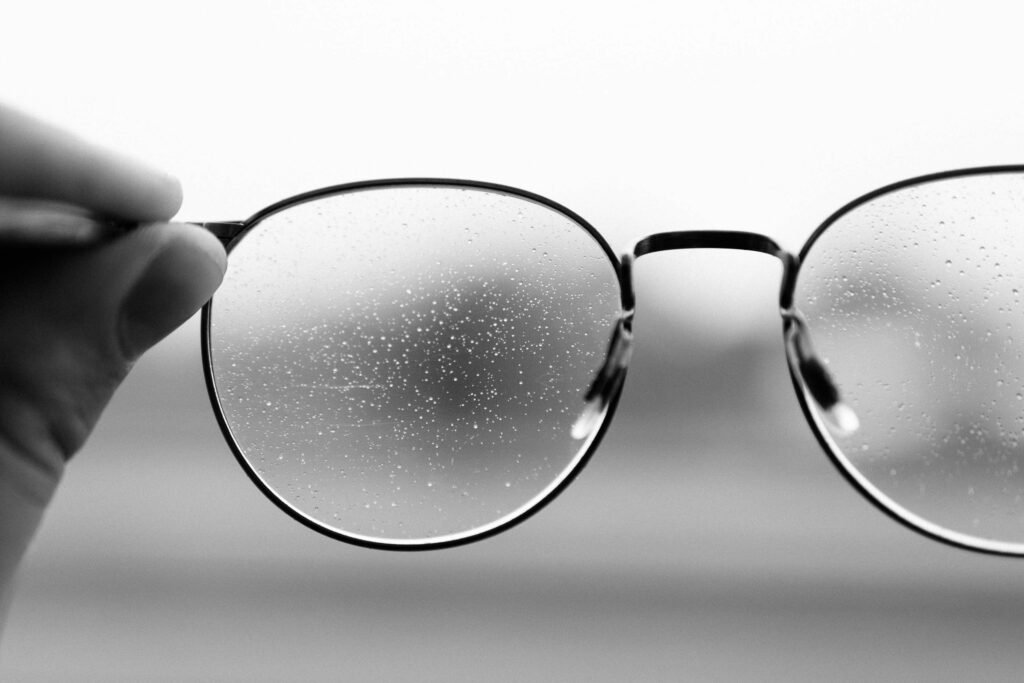
All lines on the surface of the lens are not necessarily scratches; they could be smears, undried cleaning solution residue, residue from minerals present in the water, or dust embedded in the lens coating or on the surface. Degraded coating can sometimes form opaque areas, haze, or lines that look exactly like scratches.
The first thing to try is cleaning the lens properly with tepid water, a tiny bit of lotion free washing up liquid. Rinse thoroughly and then dry with a suitable, lint free, microfiber lens cleaning cloth. If the line vanishes it was likely just superficial residue.
If the line is in the same place at any angle, it is most likely a physical scratch to the lens coating or surface.
Why lens material matters
Standard plastic, polycarbonate Trivex and high-index plastics are materials that eyeglass lenses are usually constructed from. Each varies greatly in optical characteristics and hardness. Since many lenses are softer than mineral glass some may accumulate very small scratches from harsh cleaning procedures.
Even a tiny grit may get caught between lens and fabric as it gently slides across and works like sandpaper.
Accordingly, the aim should not just be to make it look “polished.” the repair should not damage optic value and applied treatments.
Why Scratched Lenses Are Difficult to Repair
However, removing a scratch is tricky precisely because the scratch is part of the lens’s surface. To physically erase a scratch, one would essentially need to level out that part of the lens’s surface. But when you do that, you’ve created an optical problem.
A prescribed lens has a very particular curvature, thickness, and optical design, all of which work together to aim light perfectly toward your eye.
Making a modification to that lens, even an infinitesimal one, can do exactly the opposite: change that surface rather than restoring it. In some cases, especially with lenses having specific coatings like anti-reflective,UV, mirror,or blue-light, Polishing might actually compromise that coating more widely, leaving a larger cloudy patch than the original scratch.
Can You Fix Scratched Glasses With Home Remedies?
Lots of DIY fixes are offered online for scratched lenses; everything from the ubiquitous toothpaste and baking soda, car polish, furniture polish, glass cleaner, and numerous abrasive materials. The problem these fixes pose is that most of these methods do work in the form of abrasion or a chemical reaction; while they may alter what you view within a minor scratch due to light effects you most likely aren’t returning the lens to the condition it was in before any changes occurred to the prescribed surface.
Toothpaste is commonly called for to be used as a mild abrasive applied with a cloth; this can lead to further damage to the lens by creating even finer micro scratches, or by destroying the coatings on modern lenses. There isn’t just one formulation of toothpaste used; newer formulas have their own particular blend of abrasives that shouldn’t be on an optical lens, even if your lens might appear improved immediately after application.
Baking soda
Baking soda can also act as a mild abrasive. Applying a paste and rubbing it over eyewear creates unnecessary friction on a surface that needs to remain optically precise.
It is therefore not a dependable repair method for prescription lenses.
Glass or window cleaner
Household glass cleaners are designed for surfaces such as windows and mirrors, not necessarily for coated eyewear. Some formulations contain ingredients that can affect lens coatings or leave residues.
A product being labeled as suitable for glass does not mean it is suitable for modern eyeglass lenses.
Car wax and polishing compounds
Automotive products will likely only mask a minor imperfection in a fine surface for a limited time and are not intended for prescription optics as residue will more likely be left, it may affect the coatings, and it will not be consistent. An optical repair created for eyewear would work better than experimenting with an household polishing product.
What You Can Safely Do at Home
Although deep scratches generally cannot be removed with a simple home treatment, you can take several steps to determine whether the problem is actually dirt or minor surface contamination.
Step 1: Rinse the lenses
Hold the glasses under lukewarm running water. This helps remove loose dust and particles that could otherwise be dragged across the surface during cleaning, following proper eyeglass lens cleaning techniques.
Avoid hot water because excessive heat can affect some lens materials or coatings.
Step 2: Use a small amount of mild dish soap
Apply a tiny amount of lotion-free dishwashing liquid to your fingertips and gently clean both sides of the lenses.
Do not use soap containing moisturizing additives, heavy fragrances, or abrasive ingredients if you can avoid them.
Step 3: Rinse thoroughly
Make sure no soap remains on the lens. Leftover residue can create streaks that make a lens appear damaged.
Step 4: Dry With a Clean Microfiber Cloth
Use a microfiber cloth designed for eyewear. Do not use a shirt, paper towel, tissue, or rough household towel.
Small particles trapped in fabric can scratch the surface as you wipe.
Step 5: Inspect under good lighting
Look at the lens from different angles. If the mark remains visible after proper cleaning, it may be a genuine scratch or coating defect.
This cleaning process will not repair a deep scratch, but it prevents you from treating ordinary residue as permanent damage.
How to Tell Whether a Scratch Is Serious
Not every scratch has the same practical effect.
A tiny mark near the outer edge of a lens may be annoying but have little effect on your vision. A scratch directly in your central line of sight can be much more noticeable.
Pay attention to symptoms such as:
- Glare around lights
- Distracting lines in your vision
- Increased difficulty seeing clearly
- Reflections from the damaged area
- Headaches or visual discomfort while wearing the glasses
The depth and location of the damage matter more than simply counting the number of scratches.
A lens covered with numerous fine marks may also become frustrating to use even if none of the individual scratches is particularly deep.
Can a Professional Repair Scratched Prescription Lenses?
A technician can evaluate the lens and tell whether it can be fixed. Usually, it is better to just replace the broken lens instead of polishing it. The lens, prescription, coatings, frame, and the level of damage can be inspected by an optical professional.
This can be helpful if the prescription is strong, or lenses are specialty prescription lenses, include expensive coatings, or the frame has a special value to the wearer, and must keep the original frame.
The replacement lens can be installed into the existing frame as long as the frames are of useable condition, and can be a less expensive solution than replacing the entire pair.
When Lens Replacement Makes More Sense
Replacing the lens is worthwhile when scratches: Impair vision. Are in the normal range of sight. It is also useful to replace the lens when the coating has suffered more damage overall. One attempt to scrape one area off may result in a level surface which is of greater annoyance to the wearer than the actual damage.
Consider replacement if:
The scratch is deep
A deep groove cannot simply be wiped away. Attempts to grind or polish it out may alter the lens surface.
There are many scratches
Multiple scratches can scatter light and create persistent glare. Even if each mark is shallow, their combined effect may make the glasses uncomfortable to use.
The coating is peeling
Peeling or flaking anti-reflective coating is different from an ordinary scratch. Abrasive treatment can make the appearance worse.
The damage affects your vision
If the damaged area interferes with clear vision, replacing the lens is usually more sensible than trying an uncertain home remedy.
Scratched Glass Lenses vs. Plastic Lenses
While old glasses sometimes contain genuine glass lenses, the vast majority of today’s prescription lenses are made from a plastic material. Plastic isn’t scratch-proof as are some kinds of glass, though it is much lighter and more likely to resist shattering on impact. Lenses are lighter and are manufactured to provide as much of that resistance as possible depending on the type of plastic used, but their surfaces need to be kept from undue contact.
Don’t randomly use any of the various abrasive substances to clean your lenses!
As a last note, and if you aren’t sure whether you have glass lenses, your optician or optician can usually help you recognize what material is there.
How to Prevent Future Lens Scratches
Prevention is far easier than trying to restore a damaged lens.
The habits which are most useful include cleaning your glasses without rubbing the lens if you have dust on the surface. If possible, it’s important to give the lens a splash and clean off any loose debris before rubbing the material with cloth. 4. Never place the lenses downwards; instead, place the glasses inside the hard case.
If you’re unable to do this, don’t rest them on countertops, dashboards, tables, etc.
With the lenses facing down. 5. Clean the microfiber cloth as well: your microfiber cloth should always be clean. A dirty one can leave behind abrasive residue with every rub, which can damage the lens. 6. Clean your microfiber lenscloth regularly: remember to rinse them regularly and to follow the manufacturer’s wash and care instructions.
Avoid using fabric softeners on it unless the manufacturer indicates otherwise.
Daily, more effective habits 1. Try to hold the glasses by the frame; this will prevent you from smudging up the lenses by direct contact. Fingerprints are a little more challenging to remove as compared to hairline scratches caused by repeated inadequate cleaning of the lens.
2. Avoid carrying the keys, cash, pens and even small coins inside your eyeglasses’ compartment unless you have protected them carefully. 3. Ideally, pack glasses in a case before placing it in a bag or your backpack; a case is more effective in shielding against impact and contact.
Common Mistakes That Cause More Damage
People frequently clean their lenses with a dry shirt. Although clothes feel smooth, they hold dust and minute particles which can scratch the delicate coating on optics. It is also commonplace to find people using paper towels or tissues to clean their lenses.
These tissues, besides possibly leaving fibers on the lens, have a rougher quality which is unsuitable for frequent use.
Many people simply breathe on the lens and then rub it, which will just distribute the dust elsewhere and not properly lift it from the lens. Use of domestic cleaning products on your spectacle frames is common, but the coatings may not withstand anything but lens cleaning products or extremely mild soap and water mixtures. Perhaps most surprisingly is the common assumption one can simply polish scratches off a spectacle lens just like one might with common window glass; but spectables carry specialized precision optics not common, flat window glass.
What If Only the Lens Coating Is Damaged?
Coating damage can be confusing because it may look like scratches, haze, tiny cracks, or irregular patches.
Anti-reflective coatings are applied in very thin layers. Once a coating begins separating or deteriorating, cleaning will not restore it, making anti-reflective lens coating care especially important.
In this situation, rubbing harder is likely to make the appearance worse.
An optical professional can determine whether the issue is a surface scratch, coating failure, or another type of lens damage. If the prescription is still appropriate and the frame is sound, replacing the affected lens may be all that is necessary.
Should You Keep Wearing Scratched Glasses?
Small Scratches: Don’t Panic. Unless the scratch is in your direct line of vision, and causes an immediate, annoying visual disturbance, you may still be able to wear the lens to some avail. However, scratches that result in visual glare, distortion or visual interruption should be paid greater heed.
This can be especially bothersome when dealing with car headlights, street lamps or light from computer monitors.
If your glasses aren’t providing you the best possible sight, then get them looked at as opposed to applying a series of increasingly powerful scratch removal remedies yourself, while prioritizing clear and healthy vision. Don’t let yourself be fooled into believing a patch job is the answer. Safety Glasses and Children’s Specs If your damaged glasses are not for casual wearing, like in a kids, or if they are safety goggles, it’s time for them to go in the rubbish and be replaced.
A Practical Decision Guide
The best response depends on what you find during inspection.
| Lens condition | Best approach |
| Smudged or dirty | Clean properly |
| Dust causing apparent marks | Rinse and clean gently |
| One very light surface mark | Ask an optical professional about options |
| Deep scratch | Consider lens replacement |
| Numerous scratches | Consider replacement |
| Peeling coating | Professional assessment |
| Scratch interfering with vision | Replace or professionally assess |
| Damaged frame and lenses | Consider replacing the complete pair |
This approach prevents a common mistake: spending time and money trying to repair a lens that is better replaced.
When to Seek Professional Help
You could consider taking your glasses to an optician or optical laboratory for examination of the damage if you aren’t sure whether it’s a scratch or a coating defect, especially if the damage interferes with your vision. Your optician can also help when you require lens replacement and specialty lens coatings and where you are keen to keep a costly frame. Please do not attempt any robust sanding, buffing, grinding or chemical stripping of your lenses.
You may be able to make your glasses look cosmetically better, but doing so can change the lens surface and cause the ruin of hard to repeat hard coatings.
A lens replacement could also be an opportunity to update a prescription if it has changed.
Frequently Asked Questions
1.Can you fix scratched glasses at home?
Light surface marks cannot reliably be removed from prescription lenses with household products. The safest home approach is proper cleaning and inspection. Deeper scratches generally require professional assessment or lens replacement.
2.Does toothpaste remove scratches from eyeglasses?
Toothpaste is not recommended for repairing prescription lenses. Its abrasive ingredients can create additional fine marks or damage protective and anti-reflective coatings.
3.Can baking soda repair scratched lenses?
Baking soda can act as an abrasive, so rubbing it onto an optical lens may cause more surface damage. It is not a dependable method for restoring scratched eyewear.
4.Can an optician remove scratches from glasses?
An optical professional can assess the damage, but completely removing a scratch from a prescription lens is often impractical. Depending on the damage, replacing the lens may be the better option.
5.Are scratched glasses bad for your eyes?
A scratch does not necessarily harm the eyes directly, but it can interfere with clear vision, create glare, or become distracting. If the damage affects comfortable vision, professional assessment is advisable.
6.Can scratches on glasses be prevented?
Yes. Store glasses in a protective case, rinse away dust before wiping, use a clean microfiber cloth, and avoid placing lenses directly against hard surfaces. These habits can significantly reduce unnecessary surface wear.
7.Is it cheaper to replace scratched lenses or buy new glasses?
It depends on the frame, lens type, prescription, and replacement cost. If the frame is still in good condition, replacing only the damaged lenses may be more economical than buying a completely new pair.
Final Takeaway
Can you fix scratched glasses? In most cases, the answer depends on whether you are dealing with dirt, a minor surface mark, coating damage, or a genuinely deep scratch. Proper cleaning can eliminate residue that only looks like lens damage, but household abrasives such as toothpaste and baking soda are not reliable solutions for prescription eyewear. They can create additional scratches or damage specialized coatings.
If the damage appears to be a large scratch, or you’re concerned the scratch is within your line of sight, it’s always better to take them to a professional. If the frames are all OK, you might only need new lenses to regain clear vision (instead of getting an entirely new pair of glasses or contacts). Just be sure to clean them properly and store them in a case to avoid similar issues.
Conclusion
Can you fix scratched glasses? In most cases, a true scratch cannot be safely removed from modern prescription lenses without risking additional damage to the lens surface or its protective coatings. Regular dusting and cleaning can often remove debris that appears to be a scratch. Household remedies (toothpaste, baking soda) should never be counted on for effective scratch repair.
Deep scratches, those in your line of vision, or those that produce glare, distortions, headaches or general trouble with vision, most likely need new lenses rather than any treatment. If your frames remain intact, it may just be necessary to get the lenses replaced rather than a whole new pair of glasses. Cleaning, using a microfiber lens cloth and storage within a protective case should help preclude future scratches and give your current lenses a longer lifespan.








