

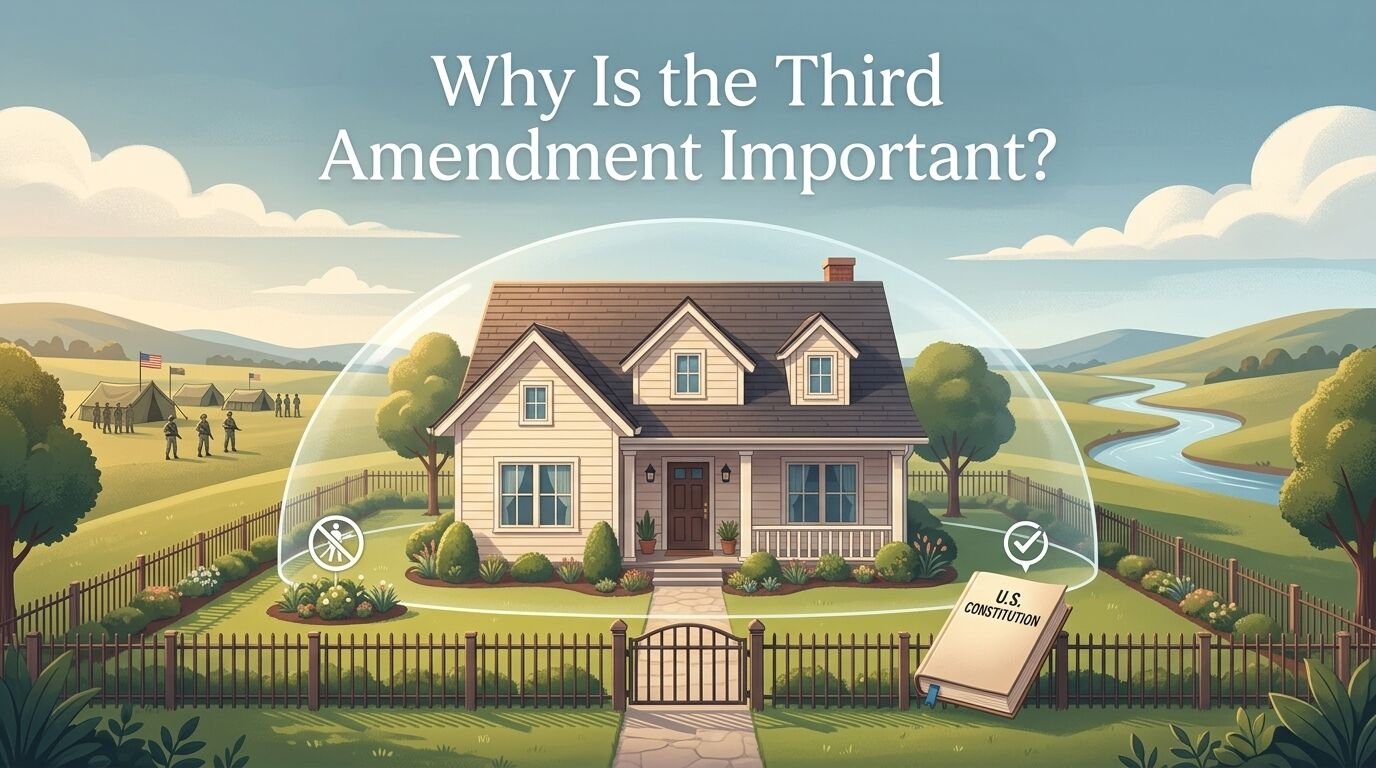
why is the third amendment important because it protects the home from being used to house soldiers without consent and reinforces the principle that military power must remain subject to civilian law. Although forced quartering is rare in the United States today, the amendment still reflects important ideas about privacy, property, consent, and limits on government authority.
In simple terms, the Third Amendment says the government cannot force soldiers to live in your home during peacetime. During wartime, military lodging must follow rules established by law. That answer is short, but the amendment’s history and legal meaning are more substantial.
The amendment grew out of colonial resistance to British military policies. It later became part of the Bill of Rights, alongside protections for speech, religion, firearms, privacy, due process, and other liberties. This article explains what the Third Amendment means, why it was created, how it works in peace and war, and why it still matters.
What Is the Third Amendment in Simple Terms?
The Third Amendment states:
The law protects homeowners from having soldiers quartered in their homes without consent during peace, while wartime quartering must follow legally established procedures.” by law.”
In simple terms, the amendment creates two rules:
- During peacetime, soldiers cannot be housed in a private home without the owner’s consent.
- During wartime, any quartering must happen according to a law—not simply because a military commander wants to use a residence.
The word quartered means housed or lodged. The amendment is not mainly about a soldier briefly visiting a home or passing through a neighborhood. It addresses the government’s use of private residences for military accommodation.
The wording also shows that wartime does not create unlimited military authority. Even in war, quartering must be regulated through law.
Why Was the Third Amendment Created?
Colonial experience with British troops
The Third Amendment was rooted in conflicts between Great Britain and the American colonies during the eighteenth century. Britain stationed troops in North America, especially after the French and Indian War. Maintaining those troops created significant expenses and political tension.
Parliament adopted Quartering Acts that required colonial governments to help provide accommodations and supplies for British soldiers. These arrangements could involve barracks, inns, public buildings, and other lodging. The historical issue was broader than the image of every soldier being placed inside a colonist’s bedroom: colonists objected to being compelled to support a military presence they did not control.
The Library of Congress describes quartering as part of a larger debate over military power, domestic privacy, and the place of the army in civilian society
The Quartering Acts
The 1765 Quartering Act came after Britain increased its military presence in the colonies. It required colonial authorities to help provide quarters and supplies for troops when existing military facilities were insufficient.
The 1774 Quartering Act was enacted during a worsening political crisis. It expanded the options available to British authorities for accommodating troops and became part of the broader colonial complaint against Parliament’s policies. The act was formally described as legislation for providing suitable quarters for officers and soldiers in North America.
The colonists’ objections involved several connected concerns:
- They were expected to help support troops stationed among them.
- The troops could enforce unpopular imperial policies.
- Local communities had limited control over Parliament’s decisions.
- Military authority could intrude into civilian life.
- Private property and household privacy could be weakened.
Fear of standing armies
Many eighteenth-century Americans and English political thinkers were suspicious of standing armies. A standing army stationed among civilians could potentially intimidate the population, enforce government policies, or become more loyal to rulers than to the people.
The concern was not that every soldier was personally dangerous. The concern was structural: if the government could place armed troops in private homes whenever it wanted, military power could enter everyday civilian life without meaningful consent.
That history helps answer why the Third Amendment is important. It is both a property protection and a limit on military authority.
Why Is the Third Amendment Important Today?
It protects the privacy of the home
The home has a special place in American constitutional protections. The Third Amendment recognizes that private residences should not be treated as government-owned military facilities.
The protection involves more than physical property. It also concerns:
- The right to control who occupies a home.
- The ability to exclude unwanted occupants.
- The privacy of domestic life.
- The security of family and personal space.
- Protection from military intrusion.
The Constitution Annotated describes the amendment’s historical purpose as connected to the principle that a person’s home should be protected from civil and military intrusion.
The Third Amendment does not answer every question about privacy. Searches, surveillance, police entry, and government inspections may involve the Fourth Amendment or other legal rules. Still, the Third Amendment contributes to the broader constitutional idea that the home deserves special protection.
It limits military power
The amendment prevents the military from treating private housing as an unlimited resource.
During peacetime, a soldier cannot be quartered in a private home without consent. During wartime, military lodging must follow a lawfully established system. That structure matters because it prevents military officials from creating their own rules whenever they claim an emergency.
The amendment therefore supports a larger principle: military necessity does not automatically erase civilian property rights.
It reinforces civilian control of the military
The armed forces operate under civilian constitutional authority. Congress makes laws, appropriates funds, and regulates the military. The president serves as commander in chief, but presidential military power remains subject to the Constitution and federal law.
The Third Amendment reflects this arrangement. It does not allow military personnel to decide independently which private homes may be used. The amendment’s wartime language specifically requires quartering to occur in a manner prescribed by law.
It preserves a historical lesson
The United States does not need to experience a widespread quartering crisis for the amendment to have value. Constitutional provisions often preserve lessons learned from earlier abuses.
The Third Amendment records the Founders’ judgment that the military should not be allowed to enter private domestic life without consent or legal authority. Its continued presence reminds government officials and the public that constitutional rights can be preventive safeguards.
Peace and War: How the Rules Differ
The amendment does not use identical language for peacetime and wartime.
| Situation | Constitutional rule | Practical meaning |
| Peacetime | A soldier cannot be quartered in a home without the owner’s consent | The protection is a direct prohibition |
| Wartime | Quartering must occur in a manner prescribed by law | War does not create unlimited authority; legal rules must govern |
| Any situation | The amendment concerns soldiers and private residences | Not every government employee or military activity falls within it |
Peacetime
The peacetime clause is the clearest. The government cannot require a private home to serve as military housing without consent.
For example, a military commander could not simply select a family’s house because it was near a strategic location and order soldiers to live there.
Wartime
The wartime clause is more qualified. It does not impose an absolute ban on every possible form of quartering. Instead, it requires the practice to be authorized and controlled by law.
That distinction matters. A declared war or military emergency would not automatically give a commander unlimited power over private homes.
What Does “Quartering Soldiers” Mean?
Quartering means providing lodging or housing for soldiers. In the historical context, it involved the government requiring communities or private residents to accommodate military personnel.
The amendment is not necessarily triggered by constitutional protections:
- A soldier visiting a friend with permission.
- A service member renting a home through a normal private agreement.
- Troops passing through a town without lodging in private homes.
- A police officer entering a home under a separate legal authority.
- A military employee living in ordinary private housing under a voluntary lease.
The specific facts and applicable law would matter in any real dispute. The key issue is whether the government is using a residence to house soldiers as part of military operations without the required consent or legal authorization.
The Third Amendment and Modern Privacy
The Third Amendment is sometimes discussed as part of a broader constitutional privacy tradition. That does not mean it creates a general rule covering every form of personal privacy.
It is more accurate to say that the amendment supports several related ideas:
- The home is a protected private space.
- Occupants have a meaningful interest in controlling access to their residence.
- Government power has limits inside the home.
- Military authority must be restrained by law.
- Property and privacy can overlap.
The Fourth Amendment is usually more directly relevant to government searches and seizures. The Fifth and Fourteenth Amendments may matter in due-process or property disputes. The Third Amendment contributes a distinct principle focused on military lodging.
The Key Modern Case: Engblom v. Carey
The leading modern Third Amendment case is Engblom v. Carey, a 1982 decision from the U.S. United States Court of Appeals for the Second Circuit. It involved correctional officers who lived in housing connected to a New York prison.
During a strike, National Guard members were placed in the residences after the correctional officers were displaced. The officers argued that the arrangement violated the Third Amendment.
The court’s analysis addressed important questions:
- Could National Guard members qualify as “soldiers”?
- Could tenants or lawful occupants have protection?
- Third Amendment Rights: Do They Apply to the States?
- Does a resident need to own the property outright to have a protected interest?
The Second Circuit concluded that National Guard members could fall within the amendment’s reference to soldiers. It also held that property-based privacy interests are not limited to fee-simple homeowners; they may extend to lawful occupants who possess a legal right to exclude others.
The case is important, but it should be described accurately. It was a Second Circuit decision, not a ruling by the U.S. Supreme Court. It also did not establish that every tenant automatically wins a Third Amendment claim. The nature of the occupancy and the specific facts remain important.
Why Engblom matters
Engblom shows that the Third Amendment is not limited to eighteenth-century homeowners. It can raise modern questions about:
- Rental housing.
- Employment-related residences.
- National Guard deployments.
- State government conduct.
- Privacy and possession.
- The Extension of Constitutional Rights to the States
Does the Third Amendment Apply to Tenants?
It may. The word “Owner” in the amendment does not necessarily mean only a person who holds the deed to a property.
In Engblom, the Second Circuit recognized that lawful occupation and possession, along with a legal right to exclude others, can create a relevant property-based privacy interest. That reasoning matters because many people live in rented homes rather than homes they own.
However, a tenant’s potential protection depends on the circumstances. Questions may include:
- Was the person a lawful tenant?
- Did the person have a right to exclude others?
- Was the housing tied to employment?
- Did the person retain possession when the alleged quartering occurred?
- What government action caused the residence to be occupied?
A general article should explain the principle without promising a legal result in an individual case.
Does It Apply to the National Guard or Police?
National Guard
In Engblom, the court treated National Guard members as “soldiers” for purposes of the Third Amendment analysis. This is one reason the case remains important.
Police
Police officers are not automatically soldiers under the amendment simply because they are armed government personnel. If police use a home as an observation post or conduct an operation there, other constitutional protections may be more relevant, including the Fourth Amendment, property law, or due process.
The distinction is based on the nature of the government personnel and the conduct involved—not merely on whether the people carrying out the action have weapons or uniforms.
Why Is the Third Amendment Rarely Used in Court?
The Third Amendment has generated little direct Supreme Court litigation. Several practical reasons help explain this:
- The specific practice of forcing troops into private homes is uncommon.
- The United States has military bases, barracks, and established housing systems.
- Modern disputes may be resolved under property, housing, Fourth Amendment, or statutory law.
- Courts may not need to reach the Third Amendment if another legal rule decides the issue.
But “rarely litigated” does not mean “unimportant.” A constitutional rule can influence government conduct before a lawsuit is ever filed. It can also serve as a structural reminder that military power remains limited.
Common Misunderstandings
It bans all military activity near civilians
No. The amendment focuses on quartering soldiers in private homes. It does not prohibit military bases, training exercises, public deployments, or every military presence in a civilian area.
It applies only in peacetime
No. The peacetime clause provides the strongest protection, but the wartime clause still requires quartering to occur according to law.
It protects only homeowners
Not necessarily. Engblom recognized that lawful occupants and tenants may have relevant privacy and possessory interests.
It is a general privacy amendment
No. It supports a broader constitutional privacy tradition, but it does not replace the Fourth Amendment or automatically decide disputes involving surveillance, searches, or police entry.
It is irrelevant because it is rarely used
That conclusion is too broad. Its direct application is uncommon, but its principles remain relevant to home privacy, civilian authority, and limits on military power.
Third Amendment Timeline
| Date | Event | Importance |
| 1765 | Parliament adopts a Quartering Act | Colonial communities face obligations connected to housing and supporting British troops |
| 1774 | Parliament adopts another Quartering Act | Quartering becomes part of the growing imperial and constitutional dispute |
| 1789 | James Madison proposes amendments | Proposed protections begin the process that produces the Bill of Rights |
| 1791 | The Bill of Rights is ratified | The Third Amendment becomes part of the Constitution |
| 1979–1982 | Events and litigation in Engblom v. Carey | A modern court considers tenants, National Guard members, and state application |
Frequently Asked Questions
Why is the Third Amendment important if it is rarely used?
It protects a basic constitutional boundary: the military cannot treat private homes as government housing without consent or lawful authority. Its rarity reflects modern military practices, not a lack of constitutional value.
What is the 3rd Amendment in simple terms?
It says the government generally cannot force soldiers to live in private homes during peacetime. During wartime, any quartering must follow rules established by law.
The Historical Reasons Behind the Third Amendment
They included it because colonists had objected to British military policies requiring communities to provide lodging and support for troops. The amendment also reflected concern about standing armies and military intrusion into civilian life.
What is the Quartering Act?
The Quartering Acts were British laws that required colonial authorities to help provide accommodations and supplies for British troops. They became part of the political conflict that preceded the American Revolution.
Does the Third Amendment protect renters?
Potentially. In Engblom v. Carey, a federal appeals court recognized that lawful possession and the right to exclude others can matter, not just formal ownership. The result depends on the facts and applicable jurisdiction.
Has the Supreme Court ruled directly on the Third Amendment?
The Supreme Court has not developed a large body of direct Third Amendment case law. One of the best-known modern decisions, Engblom v. Carey, came from the Second Circuit.
Does the Third Amendment protect people from police entering their homes?
Not generally under the Third Amendment. Police are not automatically “soldiers,” and police entry usually raises Fourth Amendment, property, statutory, or due-process questions.
Conclusion
The answer to “why is the Third Amendment important” has both historical and modern parts. Historically, it responded to colonial resistance against compelled military lodging and the broader danger of standing armies intruding into civilian life. Today, it protects the special status of the home, reinforces consent and property control, and confirms that military power must operate under civilian law.
The amendment is rarely litigated, but it is not meaningless. Its importance lies in the constitutional boundary it preserves: private homes are not automatically military resources, and even wartime authority must follow the law.








