

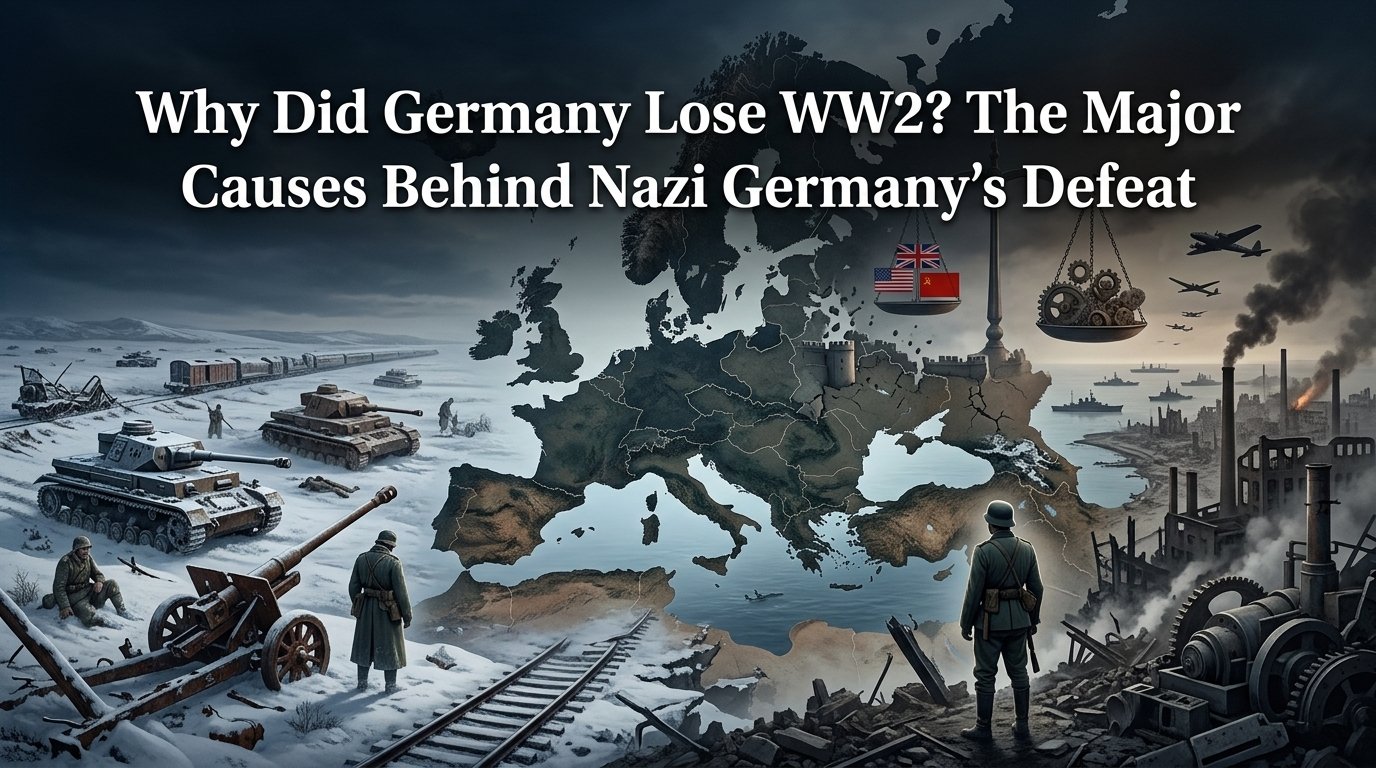
When people ask why did Germany lose WW2, they are often looking for one decisive explanation. Some point to the invasion of the Soviet Union, others to the entry of the United States, others to the military decisions of Hitler; each explanation (1) gives part of the story and (2) fails to account for the entire outcome. Germany began the war with a well equipped, well led, modern military armed with a strategy that led to spectacular early victories. Over the coming years that very same military later fought a long war against nation states with much larger manpower resources, larger factories, more raw materials, better transportation, and greater strategic depth.
Understanding why did Germany lose WW2 therefore requires looking at how these factors interacted. Germany had been very successful in short campaigns but its position became more and more difficult once war turned into the long haul, revealing the limits of prolonged military campaigns. The failure to break Britain, the decision to open a front in the East, the vast scale of the Eastern Front, the growing power of the U.S, the effects of Allied bombing, fuel and equipment shortages and the opening of a Western front all contributed to the demise of the German war effort. The key difference is between Germany’s early success on the battlefield and it’s ability to sustain a war on a world wide scale.
Nazi Germany had achieved it’s maximum territorial extent by 1942 but the strategic situation was already beginning to turn against them.
The Allies had begun to regain territory while Germany was suffering from huge losses in the Soviet Union and was becoming increasingly under pressure from the air and at sea.
Germany’s Early Success Created a Strategic Trap
One reason the question why did Germany lose WW2 can be confusing is that Germany appeared extremely difficult to defeat during the first years of the conflict. In 1939, German forces crushed Poland and, in 1940, swiftly moved through Denmark, Norway, Belgium, the Netherlands, and France. The speed of the German advance reinforced the notion that German ways of warfare were too formidable to oppose.
The difficulty was that speedy victories did not necessarily lead to a track toward final victory. The German military system depended on swift advances. When an opponent survived the opening assault, marshaled additional resources, and extended the conflict into a drawn-out war, Germany’s relative strengths came to matter less.
This problem was laid bare in the Battle of Britain. Britain was unable to be forced out of the war or to achieve the preconditions necessary for an invasion. Britain was an still active staging area for Allied forces and later became a lynchpin in the struggle against Germany in Western Europe.
This matters when examining why did Germany lose WW2 because Germany gradually created a situation in which its enemies had time to strengthen themselves. Instead of fighting a series of short wars that Germany could finish individually, the conflict increasingly became a large coalition war.
The Decision to Invade the Soviet Union
The decision to invade the Soviet Union in June 1941 was one of the most momentous of the war. Germany expected that the campaign would be quick, eliminate the Soviet military, and permit the Germans to occupy vast areas and gain access to valuable resources. That expectation was ultimately proven wrong.
The Soviet Union was huge, had great industrial resources, had large numbers of reserve troops, and was able to “mothball” factories and move them away from the advancing Germans. Factories and defense industries moved eastward, and production of aircraft, tanks, and other weapons grew. Britain and the United States also helped the war effort by providing supplies.
Eventually, the German advance struck terrible logistical problems. The distances increased, supplies were more difficult to supply and defend, and the German forces met better and more determined opponents. The failure of Germany to bring the campaign to an immediate conclusion meant that they were committed to a major military effort with huge numbers of soldiers, vehicles, aircraft, bombs, fuel and equipment.
This is central to why did Germany lose WW2 because the Eastern Front became a war of extraordinary scale. Germany could not simply occupy territory and assume that the Soviet Union had been defeated. It had to continuously supply armies operating hundreds or thousands of miles from Germany while facing an opponent capable of rebuilding and launching major counteroffensives.
Stalingrad Changed the Direction of the War
This was the battle that brought the biggest shift in theEuropean war. 1942 saw Germany once again open a major attack towards the south of the Soviet Union that had vital links to the oil of the Caucasus region. German troops also became engaged in heavy fighting for Stalingrad. The subsequent Soviet counter-attack in November 1942 resulted in a pincer movement that encircled the German Sixth Army and the German allies in the area.
The captured German troops surrendered in the period from 31st January to 2nd February 1943.
This enormous loss was a huge setback and also showed that forces could be encircled and destroyed on an enormous scale.
Stalingrad did not single-handedly determine why did Germany lose WW2, but it exposed the growing strategic weakness of the German position. Germany had already committed enormous resources to the Eastern Front, and the campaign had failed to produce the decisive Soviet collapse German planners expected.
Following Stalingrad, German troops were conducting more and more operations from a defensive stance in the East. The Soviet military maintained its capacity to conduct large scale operations, while Germany was unable to replace its losses at the same rate.
The Eastern Front Consumed Germany’s Military Strength
The Eastern Front is essential to understanding why did Germany lose WW2 because the overwhelming scale of fighting there consumed a huge portion of German military power.
Germans were not fighting a limited traditional battle within a defined geographical space. The front line was laid across vast territories. Major offensives moved from place to place hundreds of miles apart. Each advance required considerable increase in the geographic scale of transportation and supply networks.
Soviet Union was also proving capable of absorbing enormous losses without surrender. The Germans overestimated the ability of the Soviets to withstand the pressure and underestimated the size of the Red Army. The Soviet were becoming much more effective at mounting large scale coordinated offensives. In 1944 and 1945 the Red Army pushed westward while the Germans retreated east. Eventually the Eastern Front came to constitute one of the main pathways through which Allied military power could be brought directly to bear on Germany.
Germany Faced an Industrial Disadvantage
Another major part of why did Germany lose WW2 was the industrial balance of the war. Modern warfare requires much more than highly trained soldiers. Armies require enormous quantities of fuel, ammunition, aircraft, trucks, tanks, artillery pieces, replacement parts, communication equipment, and food.
Germany had a substantial industrial base, but fought against a coalition of the world’s biggest industrial powers. The US alone had hundreds of billions of pounds of manufacturing capacity to produce and supply vast amounts of military equipment for the war effort.
The USSR, despite the devastation wrought on it by the Germans, also made huge leaps in military production: manufacture was gradually pulled away from the danger zones and shifted towards the increasingly strong Red Army. This spelled the beginning of a long-term issue for Germany: a sophisticated weapon might look impressive on the battlefield, but a military can’t fight a prolonged war if it can’t replace its losses, repair vehicles, provide fuel, and have enough trained personnel in the field.
Fuel Shortages Became Increasingly Serious
Fuel was also a major weakness. Mechanised warfare relies heavily on plentiful supplies of petroleum, and Germany lacked a never-ending source of domestic oil, highlighting the importance of military fuel logistics. The German strategy, accordingly, was to secure the regions that supplied oil and the synthetic fuel production that might provide it. The failure to obtain those supplies meant a worsening situation as the war dragged on.
The demand on fuel, too, was exacerbated by Allied bombing of German transportation, oil production, and industrial targets. As the Germans neared the end of the war, fuel shortages increasingly curtailed the number of tanks, aircraft, trucks, and other military equipment that could be moved.
This helps explain why did Germany lose WW2 from a practical perspective. A military formation can possess excellent equipment and experienced personnel, but without fuel it cannot maneuver effectively. The war increasingly became a contest not only of battlefield skill but also of industrial endurance.
Allied Bombing Damaged Germany’s War Economy
After 1942, Allied bombing shifted towards the industrial and transportation infrastructure of Germany. Bomber attack alone did not destroy Germany and much German industry was still producing at high levels. However, it was costly to the Germans who had to allocate resources to defending against the air attack, the construction of new aircraft, destruction and dispersal of assets and repairing of damaged infrastructure.
German cities and industrial areas were heavily bombed while transportation networks were the target of frequent attacks.
Oil and other strategic industrial installations were also targeted increasingly often.
The significance of bombing becomes clearer when considering the larger question of why did Germany lose WW2. Germany was being pressured from multiple directions simultaneously. Its armies needed equipment at the front while its factories and transportation networks were being attacked from the air.
This led to a snowball effect. Funds used for repairing the damaged railway, road, or canal could not be used elsewhere. The aircraft needed to defend German territory could not always be concentrated on the Front against the Allies. The destruction of German industry slowed the flow of raw material and finished equipment.

The United States Transformed the Allied War Effort
America’s entry into the war shifted the balance decisively. German forces had to contend with an enemy that had vast industrial strength, huge manpower reserves, worldwide capabilities to transport supplies, and the strength to lend support to Britain and the Soviet Union whilst developing its own military might. America was not the only nation to crush Germany, Britain, the Soviet Union and other allies also played their part, with the Eastern Front being the primary focus for the destruction of the German military. However, the American strength economically and militarily made the task of beating Germany all that more difficult.
This is why why did Germany lose WW2 cannot be reduced to a single battlefield. Germany eventually confronted a coalition capable of maintaining pressure across several theaters simultaneously.
Germany Had to Fight on Multiple Fronts
However, these grand plans became less and less feasible as Allied operations increased. In 1943, Allied troops invaded Italy, bringing yet another theater of war with which to contend. And then came the Normandy Invasion of June 6, 1944, an enormous landing in Western Europe that ultimately pushed the Germans out of Normandy and established a very large stake on the continent for the Western Allies.
The Western Front became important in a very real way, because Germany could not longer focus the bulk of its resources against a single, primary adversary. Its forces, aircraft and armored units, ammunition and leaders would have to be spread among the various fronts.
With the success of D-Day and other grand Allied operations, this goal was achieved, and German armies were pushed eastward. By 1944, much of the territory that the Germans had controlled was in the hands of the Allies.
Hitler’s Strategic Decisions Made the Situation Worse
Another part of why did Germany lose WW2 concerns Adolf Hitler’s increasing involvement in military decision-making. Hitler sometimes supported aggressive operations that achieved important results, but he also made decisions that limited commanders’ ability to retreat, reorganize, or preserve forces.
The pursuit of holding on to hold specific positions at almost any price could have changed time into disasters. An army on the edge of encirclement has a chance of saving force if it makes a proper retreat. Orders to fight on at all costs can deny that decision.
The disaster at Stalingrad was a key lesson in the risks of denying any strategic retreat. Once the German Sixth Army was in encirclement, circumstances became less and less survivable. Hitler’s leadership also contributed to Germany’s refusal to acknowledge how dramatically the strategic situation had changed after 1942. The German government continued to pursue military goals despite the terrible conditions.
However, it would be an oversimplification to suggest that Hitler is solely to blame for the defeat. Underlying issues included Germany’s limits on resources, the size of the Anglo-American alliance, the huge extent of Soviet defiance, and the enormous distances involved.
Germany Underestimated Its Opponents
One recurring theme in why did Germany lose WW2 was inaccurate strategic assumptions. German leaders repeatedly underestimated the ability of their opponents to recover.
The USSR was thought to be doomed to fail so soon after the beginning of the war, in 1941. Nevertheless the Soviets moved factories to the east, threw more men into the fight and soldiered on.
Meanwhile, Western Allied capacity was also overestimated. America delivered by far the largest proportion of militarily useful equipment to the world and Britain stayed in the war.
Why did this matter? Because every planning project assumes something. When you plan a campaign based on an enemy collapsing within weeks or months and he hangs around for years, a lot of your resource calculations go out the window.
Germany’s Military Technology Could Not Solve Strategic Problems
During the war Germany developed many technologically sophisticated and deadly weapons. The Panther tank, Tiger tank, jet aircraft, advanced submarines, rockets and other inventions have been studied extensively by military buffs and historians.
But something may be individually technically superior does not guarantee victory. Expensive weapons could be hard to manufacture, hard to maintain, and require more fuel and spare parts.
Germany is become and more desperately needed items such as a large number could be manufactured and operated under the difficult conditions of the battlefield. A technical sophisticated weapon that has too late, or too few could not make up for a strategic lack.
This distinction is useful when considering why did Germany lose WW2. The war was ultimately decided by the combined performance of armies, economies, transportation systems, intelligence, logistics, industrial production, manpower, geography, and strategy.
Germany’s Alliance System Was Also Limited
The Axis partners of Germany lacked the strength of the United Nations coalition which came to Germany’s aid. Italy’s military failures eventually led to an obligation for Germany to divert troops to the Mediterranean and the Italian theater. Romanian forces also took severe losses on the Eastern Front.
Other Axis powers had different strengths and interests.
The remaining United Nations coalition, despite the conflicts among its constituent parts, was able to maintain an extended war of multiple fronts against Germany. Britain was still fighting. The Soviet Union stopped and eventually pushed back the German invasion, and the United States brought vast factories and military manpower to the challenge. Germany thus entered a war in which its enemies grew stronger while the Germans’ options shrank.
Why Germany Could Not Recover After 1944
By 1944, Germany could no longer hope to return to the situation that existed in 1940. The Soviet Union was moving in from the East and the Western European nations and Italy had crossed the Rhine. There was a continuous air blockade on the German cities and manufacturing centers and the military had sustained years of defeats.
The German Ardennes offensive was a transient surprise for the Western Allies in December 1944, but it was only temporary in terms of restoring the overall strategic situation.
The offensive also exhausted German resources and did not markedly alter the relative balance of power. By 1945, the Soviet army had reached Berlin and the Western Allies had crossed the Rhine; the German military was nearly disintegrated and had severe shortages.
The question why did Germany lose WW2 therefore has a different answer in 1945 than it might have had in 1940. By 1945, Germany was not searching for a way to win a conventional campaign. It was attempting to delay complete military collapse.
The Final Collapse of Nazi Germany
A terminator short years Indeed, this happened so relquickly. Soviet-occupied Berlin in April 1945. April 25 Americans, who met in the Torgau on the Elbe River, effectively splitting Germany in two
Hitler committed suicide in April 30 Berlin surrendered to Soviet forces The German leaders later agreed to unconditional surrender with the Germans surrender document being signed at Reims in May 7 1945 In the in May 8 the heads of the German armed forces also ordered to stop active military operations effectively ending World War II in Europe. According to records held by the surrendered document is declared an unconditional surrender of all German forces by the German High Command to the Allies expeditionary force.
What Was the Single Biggest Reason Germany Lost?
There is no historically responsible way to reduce why did Germany lose WW2 to one simple cause. The defeat developed from the interaction of several strategic failures and Allied strengths.
The Eastern Front also prevented Germany from winning a quick victory over the Soviet Union, as well as costing huge quantities of troops and other resources. The defeat at Stalingrad taught the lesson about overextending your front. US mobilization increased the strength of the Allied coalition.
Britain stayed in the war and acted as a valuable Western base.
Allied bombing destroyed war production and infrastructure. D-Day opened a Western Front. Soviet operations consistently pushed Germans back.2 shortages of oil, manpower, transport, and equipment became increasingly severe. The most helpful way to think of the German defeat is as a pattern of multiple failures and failures of opportunity.
Common Misunderstandings About Germany’s Defeat
Some of the most common of such misconceptions are: “Germany lost because of the Russian winter”: weather was responsible for many difficulties experienced by German troops, especially during the 1941 campaign, but it is not enough to explain the defeat. The Soviet Union remained in the war for many more years and it was a matter of operational skill, manpower, production, logistics, and offensive campaigns at successive dates.
“D Day defeated Germany”: although the invasion of Normandy was tremendously important, German losses on the Eastern Front had been enormous by June 1944, and the Soviet Union had been fighting continuously since 1941.
“There were inferior armies or weapons”: although German armies scored notable military successes and German military leaders proved very skilled, tactical and operational skill alone was insufficient to counter the strategic decline of the German war effort.
“Hitler decided everything”: even though the decisions of the Führer were significant, the German coalition faced fundamental structural problems which surpassed his personal influence.
What Can We Learn From the Defeat?
The historical lesson behind why did Germany lose WW2 is broader than military history. A country can possess a powerful military and still lose if its strategic objectives exceed its resources.
So the Germans won early spectacular battles because they could concentrate their strength and seek early victory. But that became harder as the war went on. The war shows what a huge role logistics play in warfare; no army can sustain itself without fuel, bullets, food, trucks, replacement equipment, and bodies to replace the dead. And it illustrates why one should always put strategic suppositions to the test of reality; as an adversary holds out longer than one had expected, a strategy based on early victories becomes hazardous.
The war also shows why coalition strength is crucial; the Germans faced several major powers that could reinforce each other financially and militarily through wartime strategy. Once Germany failed to knock out major enemies early, the long term game was severely tilted against it.
Conclusion: Why Did Germany Lose WW2?
So, why did Germany lose WW2? Germany lost because its early strategy failed to produce a decisive victory, while the war expanded into a prolonged conflict against a much stronger coalition. The invasion of the Soviet Union had created an enormous Eastern Front that the Germans could not hope to win decisively.
Stalingrad proved a decisive turning point, and the rapid recovery of the Soviet industrial and military potential eventually came to exert continual pressure on the Germans. Britain remained in the war, the United States offered large amounts of industrial and military support, and the Allied bombing threatened to break down the German economy and hamper its transports. The opening of a Western Front in the shape of the Normandy Landings in the summer of 1944 created yet another front to stretch the Germans’ resources, and they had to disperse the already-stretched German armies.
By 1945 Berlin was surrounded, Hitler was dead, and the German armed forces surrendered unconditionally in May. The evidence therefore suggests a ‘cumulating strategic failure’ rather than a single catastrophic event.
Understanding why did Germany lose WW2 means understanding how military ambition, geography, logistics, industrial capacity, coalition warfare, and strategic decision-making interacted over six years of conflict.
Frequently Asked Questions
Why did Germany lose WW2 despite having a strong army?
Germany’s military was formidable and well-prepared, especially in the first years of the conflict, but military strength was not enough. In the end, Germany had to contend with the Soviet Union, Britain, and the United States, and other Allied nations in multiple theaters. The long war required massive use of manpower, fuel, industrial production, transport, and replacement equipment.
Did Germany lose WW2 because of the Soviet Union?
Soviet “liberation” The Soviet Union was important in the defeat of Germany, particularly in the East. The German offensive was unable to wipe out the Red Army, which fought as a reserve, and with the attrition to take the Germans by surprise, the Red Army advanced in massive counterattacks towards Germany. They entered Berlin in 1945.
Was Stalingrad the main reason Germany lost WW2?
Although the Battle of Stalingrad was one of the most significant turning points, it was not the primary factor in Germany’s loss. The battle resulted in the loss of a significant number of troops from a significant German field army and was one of the factors leading to the German strategic retreat in the East.
How important was D-Day to Germany’s defeat?
D-day was extremely significant because it created a Western Allied front in France. It was therefore part of the campaign of the Western Allies to draw up strength in the west of Europe and move closer to Germany. But it must be considered in relation to the heavy human and material losses inflicted by the Soviet Union before D-day, and not as the sole cause of defeat for Germany.
Did the United States defeat Germany by itself?
No. The destruction of Nazi Germany was the result of a grand alliance. The United States entered the war with an immense military force, an incredible industrial capacity, and a substantial amount of logistical capabilities and support for Allied operations, while Britain, the Soviets, and many other Allied powers played.








