

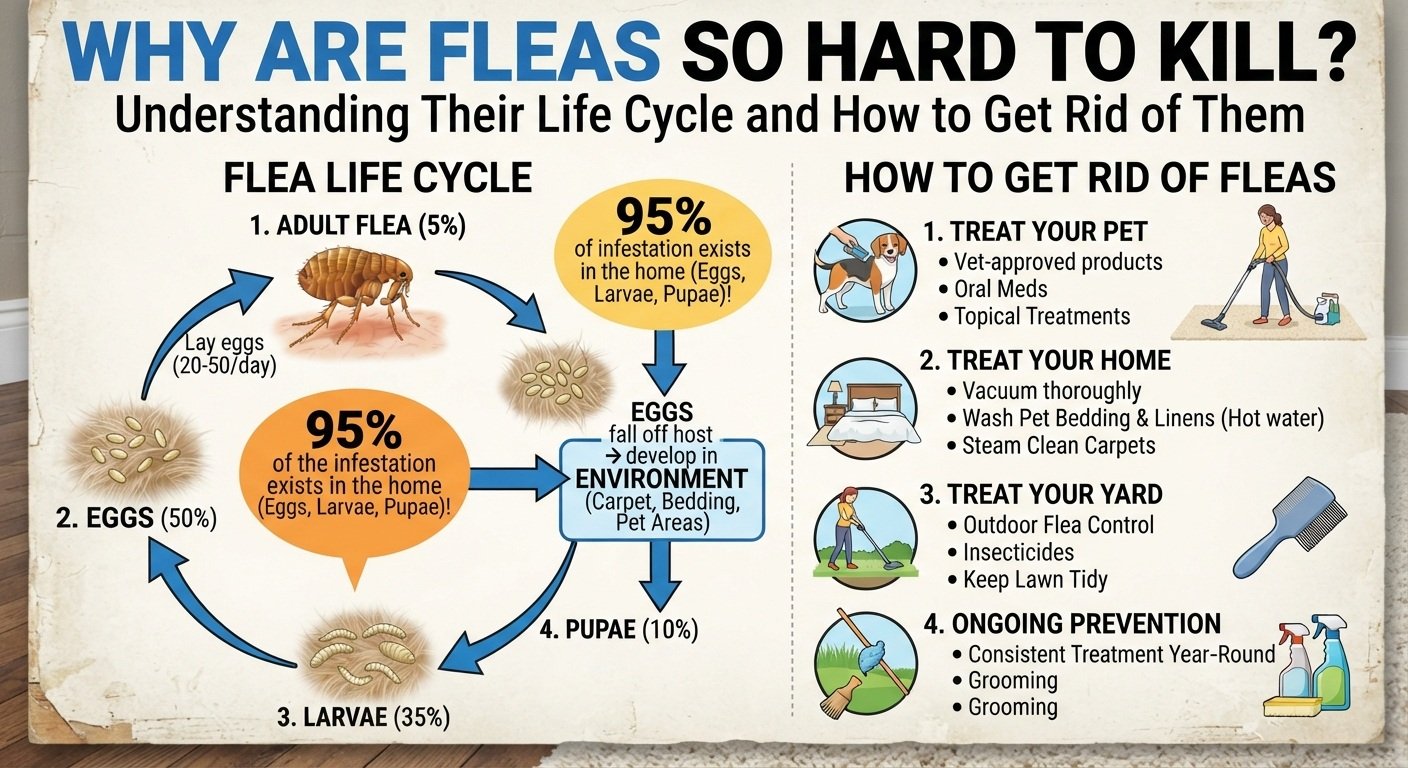
It seems virtually impossible to eradicatet fleasin the home, simply treating those seen is often never enough. An egg, larva or pupa will escape this one-time treatment and in a few days or weeks can reproduce a new adult and start it all over again. Small size, relatively rapid breeding, protected development in the environment and the protective pupal stage all give fleas long-term survival.
The main concept one needs to understand is a flea infestation is more than just fleas existing on your dog; they exist on the pet and within the environment. Carpets, furnishings, bedding, cracks and edges are also ideal places to host development where flea habitats include pet feces for larvae as well as sheltered, dark, protected areas for all stages of development.
Proper treatment for these pervasive insects can’t only include a spray treatment to present fleas present or a single de-flea treatment of affected pets; it will include treatment for affected animals, proper cleaning procedures and a long-term treatment plan to prevent the emergence of newly developing adults.
What Makes Fleas So Difficult to Eliminate?
Short answer: It is frustrating to deal with fleas since only a part of an infestation is seen with flying insects. Flea eggs, larvae, and pupae can hide in your environment and pupal stage is highly resistant to many chemical treatments. Adults can emerge as much as two weeks after most of the apparent fleas were treated.
A flea’s life cycle generally includes four stages:
- Egg
- Larva
- Pupa
- Adult
Each stage behaves differently, which makes complete control challenging.
Adult fleas are the stage most people notice because they live on animals and feed on blood, but understanding the complete flea life cycle is essential because eggs, larvae, and pupae can develop in the environment. Understanding their complete life cycle helps explain why are fleas so hard to kill, as adults represent only part of the total population.
An egg is dropped or passed out of an animal and into the environment. The larvae develop in suitable and secure spots of organic debris. Eventually cocoons form around the larvae, and they go to the pupil stage and wait in that until the time is right for the adult flea to hatch.
This means a ‘clean’ animal can be carrying fleas while the flea population is growing around the home.
The flea life cycle explains repeated infestations

Adult females can lay eggs after feeding, and those eggs may drop into areas where an animal rests or spends time. This complex life cycle helps explain why are fleas so hard to kill, because the eggs develop into larvae under suitable conditions. Larvae then mature and form pupae inside protective cocoons, allowing them to remain hidden from many flea-control methods until they emerge as adults.
At last, an adult flea will emerge if the conditions and relevant stimulus signals a potential host present nearby.
The frusturation that arises from this is being able to kill adult fleas on some days, but leaving immature stages alone. Soon afterwards, more adult fleas will appear, and make it look as though your treatment was a total failure.
Most times it may not be that every single flea survived the treatment, rather there were all kinds of flea stages there all at once, that didn’t react to the same one control agent.
Why Killing the Fleas You See Isn’t Enough
One of the most common mistakes is focusing exclusively on adult fleas.
Suppose a dog has several visible fleas. You remove or kill those insects and wash the dog’s bedding. A few days later, you notice more fleas. It is easy to assume that the original treatment did nothing.
But the newly noticed adults may have developed from eggs or pupae that were already present elsewhere.
Eggs can spread throughout the home
Eggs also drop off the host’s coat and can become buried in the host’s habitat such as carpet, rugs,pet bedding, and furniture. Because of their size it is easy to not see flea eggs.
As a result, an infestation can extend beyond the animal itself.
Larvae stay out of sight
A pet can often be found containing flea larvae that don’t typically jump around, but rather hide in safe environmental conditions and consume detritus and materials found with adult fleas.
Since, visually inspecting doesn’t mean much this way.
Pupae have an extra layer of protection
The pupal stage is of special importance. The developing flea is surrounded by a protective cocoon, which can give some degree of protection against environmental factors, and can minimize the effect of certain insecticides.
A pupa is dormant in the cocoon until favourable conditions for hatching trigger emergence. Such environmental stimulus signals for emergence of a flea may include vibration, warmth, CO 2, or other cues indicating host proximity.
That is one reason an infestation may appear to “come back” after cleaning or treatment.
Environmental Conditions Can Help Fleas Persist
Fleas do not live equally well in any environment; there are many factors involved such as, ambient temperature, humidity, available shelter and host availability.
Domestic environments are especially appealing because pets return to the same resting areas repeatedly. Fur fibers, carpeting, cracks in floors or furniture and animal bedding can protect juvenile flea stages.
Warm indoor temperatures also permits a much longer cycle, not just a short season outdoors.
As a result, outdoor pest activity may seem to subside; even so, flea life continues indoors.
Pet behavior matters, too
Animals naturally take up a significant amount of time at rest. An animal’s preferred bed or sofa, rug, or a favored corner will attract eggs and debris repeatedly. The locations not treated, become significant sites of re-infestation. The same rules apply for an automobile, pet carrier, pet blanket, etc., at which an infected animal spends a significant amount of time.
Why Flea Control Often Takes More Than One Treatment
Another reason flea problems are frustrating is that control is usually a process rather than a single event.
A treatment may kill many adult fleas on the animal, but immature stages already present in the environment may continue developing. This is one reason why are fleas so hard to kill, as newly emerged fleas can continue the infestation if they are not controlled effectively. When they reach maturity they must meet an effective control program before they mate.
Therefore a control program can take time depending on the level of infestation and the products used.
This does not suggest that you apply a flea product to your pet without advice and over use is detrimental and potentially harmful to the pet and the household members.
Ensure that you follow the product guidelines accurately and use both the best available product on your pet along with environmental control.
How to Get Rid of Fleas More Effectively
Successful flea management generally requires attacking the problem from multiple directions, alongside consistent pet care and grooming tips that support overall animal health.
1. Treat every susceptible pet appropriately
If there are multiple pets in the household, not treating all of them will keep the infestation going. Products used for dogs must be safe for the individual pet and not for all animals and should correspond to the age, weight, and general condition. Do not ever believe that if a flea treatment is effective in one species, it is safe for another.
Cats should not be underestimated as there are materials found in dog fleas products that will harm them.
Ask a vet as opposed to trying to create your own flea treatment from different kinds.
2. Vacuum frequently and thoroughly
Vacuuming is one of the most useful environmental measures because it can remove flea eggs, larvae, pupae, and organic debris from areas where they develop.
Pay particular attention to:
- Carpets and rugs
- Areas beneath furniture
- Upholstered furniture
- Along baseboards
- Pet sleeping areas
- Cracks and crevices
- Frequently used rooms
Regular vacuuming is more useful than a single cleaning session because new fleas can emerge over time.
Empty the vacuum according to the manufacturer’s instructions, especially when dealing with an active infestation.
3. Wash pet bedding
Wash bedding and washable fabrics used frequently by pets. Appropriate washing and drying can help remove flea stages from these materials.
Focus on items the animal uses repeatedly rather than assuming that washing one blanket solves the entire environmental problem.
4. Consider environmental treatment when necessary
For established infestations, household flea control products may be useful and can help explain why are fleas so hard to kill when multiple life stages are present. Some products contain insect growth regulators, which interfere with flea development rather than simply targeting adult insects, helping address immature stages that may otherwise continue the infestation.
The correct product depends on the situation, the environment, and the animals in the household. Always read and follow the label instructions, including restrictions concerning people and pets during application.
If an infestation is severe or persistent, professional pest control may be appropriate.
A Practical Step-by-Step Flea Control Plan
A coordinated approach is usually more effective than repeatedly reacting whenever you spot a flea.
Step 1: Inspect the animals
Look for signs of flea activity, including scratching, biting at the skin, flea dirt, or visible adult fleas. A fine flea comb can help identify evidence that is difficult to see otherwise.
Step 2: Choose an appropriate veterinary flea treatment
Use a product designed for the specific animal, and follow its dosing and application instructions exactly; the FDA guidance on safe flea and tick products can also help owners understand why products must be selected according to the animal and label directions.
Do not stack multiple flea treatments unless a veterinarian or product label specifically indicates that doing so is appropriate.
Step 3: Clean the environment
Vacuum carpets, furniture, floor edges, and pet resting areas. Wash suitable bedding and fabrics.
This step matters because many flea stages are found away from the animal.
Step 4: Continue environmental control
Repeat cleaning as appropriate rather than stopping after the first successful session. Newly emerging adults may appear even after substantial progress has been made.
Step 5: Monitor the pets and home
Continue checking for fleas and signs of activity. If flea numbers remain high despite following the treatment directions, reassess the strategy rather than simply increasing the dose or frequency.
Step 6: Address outdoor sources if relevant
If pets spend time outside, consider areas where they rest frequently, especially shaded, protected locations. Outdoor control is not always necessary, but it can matter when animals repeatedly encounter fleas outdoors.
Common Mistakes That Let Flea Infestations Continue
Treating only the pet
This is perhaps the biggest problem. The animal is usually the most visible part of the infestation, but the home can contain many immature stages.
Treating the host without addressing the environment can allow newly emerging adults to continue the cycle.
Stopping as soon as adult fleas disappear
Seeing no fleas for a few days does not necessarily mean every developmental stage has been eliminated.
Continued monitoring and appropriate follow-up are important.
Using too much flea product
More product does not automatically mean better control. Excessive or inappropriate use can increase the risk of adverse effects.
Always follow the label and seek veterinary guidance when necessary.
Using household chemicals incorrectly
Some people respond to persistent fleas by mixing products or applying pesticides to areas where they are not intended to be used.
That can create unnecessary risks. Household pest-control products should be used exactly according to their labels.
Ignoring other animals
If a household contains multiple dogs, cats, or other susceptible animals, one untreated animal may help sustain the infestation.
A household-wide approach is often necessary.
Relying on one cleaning session
A single deep clean can help, but it may not account for flea stages that emerge later.
Consistent cleaning and appropriate treatment are more useful than expecting one intervention to solve every stage immediately.
Why You May Still See Fleas After Treatment
Finding an occasional flea after beginning treatment does not automatically mean the product is ineffective.
Previously developing fleas may continue emerging from protected areas. The important question is whether the overall infestation is declining over time.
If flea numbers remain unchanged or increase despite correct product use and environmental cleaning, several possibilities should be considered.
Several factors can explain why are fleas so hard to kill. The treatment may not be appropriate for the animal, the infestation may be extensive, the environment may not have been adequately addressed, or reinfestation may be occurring from another animal or location.
In these situations, changing products repeatedly without understanding the cause can make the situation more complicated.
When Professional Help Is Appropriate
A veterinarian should be involved when a pet has a significant flea infestation, especially if the animal is very young, elderly, pregnant, debilitated, or showing signs of illness.
Heavy flea burdens can be particularly concerning in small animals because blood loss can become significant.
Veterinary advice is also useful when a pet develops severe itching, skin damage, hair loss, or other persistent symptoms. These issues can help explain why are fleas so hard to kill, especially because fleas can contribute to flea allergy dermatitis in susceptible animals, meaning that even relatively few bites may cause substantial irritation.
A licensed pest-control professional may be helpful when fleas remain established in the home despite appropriate pet treatment and environmental cleaning.
Professional assistance can be especially valuable when the infestation involves multiple rooms, difficult-to-treat areas, or repeated reinfestation.
Special Situations to Consider
Homes with cats

Cats require careful product selection. A treatment that is safe for dogs is not automatically safe for cats.
Never apply a dog-only flea medication to a cat unless a veterinarian has specifically confirmed its safety.
Homes with multiple pets
Treating only the animal showing obvious symptoms may leave the infestation active. Discuss appropriate prevention and treatment for every relevant pet with a veterinarian.
Fleas in apartments
Shared buildings can complicate pest control. Fleas may be introduced through pets, people, or wildlife and can persist in areas outside one individual apartment.
If the problem repeatedly returns despite appropriate control, the broader building environment may need to be considered.
Outdoor exposure
Animals that frequently visit yards, kennels, parks, or areas used by wildlife may encounter fleas again even after successful treatment at home.
In those cases, ongoing prevention can be more useful than repeatedly treating an established infestation.
How Long Does It Take to Completely Control Fleas?
There is no universal timeline because results depend on the severity of the infestation, environmental conditions, treatment used, and whether every relevant animal and area is addressed.
Adult fleas may be killed relatively quickly by an effective treatment, but environmental stages can take longer to emerge.
This distinction is crucial. Fast adult-flea control and complete household control are not necessarily the same thing.
A household can look much better within a short period while residual developmental stages are still present. Continued prevention, cleaning, and monitoring help prevent those emerging adults from restarting the reproductive cycle.
If the infestation is not clearly improving after following the product instructions and environmental measures, seek professional advice instead of repeatedly escalating treatment yourself.
Final Takeaway
One reason flea infestations appear to be so unmanageable is because the largest portion of the flea population remains unseen. The adult flea is only part of the problem, while the eggs, larvae and more particularly the pupae can remain dormant in the environment and emerge as adult fleas a significant period later. They are incredibly good at hiding in carpets, bedding, upholstered furniture and protected spaces meaning single cleaning treatment is unreliable.
The overall best strategy is to combine an effective treatment for all capable pets with diligent cleaning and observation of every room, plus a lot of patience whilst emerging stages of the flea cycle mature. Avoid using excessive amounts of pesticides or mixing treatments inappropriately without professional advice. If the infestation is ongoing, your vet or a specialist pest controller will be able to establish the source it is feeding off.
Knowing the life cycle allows a different perspective in dealing with the situation – you stop treating the individual insect and treat the infestation.
Conclusion
These creatures are tough to rid yourself of because the adult fleas you see are only a piece of the puzzle. The eggs, larvae and pupae can remain hidden under your carpets, furniture, bed linens, in the nooks and crannies, etc. The pupal stage can be quite difficult to eliminate because its protective cocoon keeps it well sheltered, and the adult flea may not emerge from the pupal stage until conditions indicate that a blood-meal-host is nearby.
The most effective approach is to break the entire life cycle rather than simply killing the fleas you can see. This is a key reason why are fleas so hard to kill, as eggs, larvae, and pupae can remain in the environment even after adult fleas are eliminated. Treat pets with an appropriate flea-control product, vacuum and clean areas where animals spend time, wash their bedding, and continue monitoring after the first treatment. Moderate or severe infestations can take time to fully control, so seeing a few newly emerged fleas does not necessarily mean the treatment has failed.
FAQs
1. Why are fleas so hard to kill?
Fleas are difficult to eliminate because they have several life stages, and not all of them are equally vulnerable to treatment. Adult fleas live primarily on animals, while eggs, larvae, and pupae develop in the surrounding environment. The protective cocoon around the pupal stage can make this stage particularly difficult to eliminate.
2. Can fleas come back after treatment?
Yes, the reason they do come back is that the eggs, larvae, or pupae may already be present in the home at the time of treatment, as newly-hatch adult fleas may not appear until several days later, and there is then no infestation for the fleas (eggs, larvae, pupae) on. Keeping house cleaning regimes and flea preventative measures up.
3. How long does it take to get rid of a flea infestation?
The timeframe varies according to the severity of the infestation, environmental conditions, and how consistently pets and their surroundings are treated. Moderate to severe infestations may take several months to fully control because immature stages can remain in the environment.
4. Does vacuuming get rid of fleas?
Vacuuming will help remove some flea eggs, larvae, and pupae from the carpet and so forth but alone it can typically not eradicate the fleas all by itself. Vacuuming can and should most definitely be used as part of a comprehensive program when applied in conjunction with a reliable flea control product on pets and other means.
5. Why do I still see fleas after treating my pet?
New adult fleas may continue emerging from pupae that were already present in the environment. The treatment may be killing fleas on the pet while previously developing stages continue their life cycle elsewhere. Continued prevention and environmental control are therefore important.
6. Should I treat all my pets for fleas?
Any susceptible pets sharing the same house should have any flea control or treatment administered correctly. Untreated pets will continue to feed on and produce more fleas, a correct product for your individual animal species and age, weight and health must be used-seek advice from the product and the veterinarian.
7. Can fleas live in carpet?
Yes. Flea eggs, larvae, and pupae can develop in carpet, particularly in protected areas where pets spend time. Larvae tend to avoid light and can remain deep within carpet fibers or other sheltered locations.








