

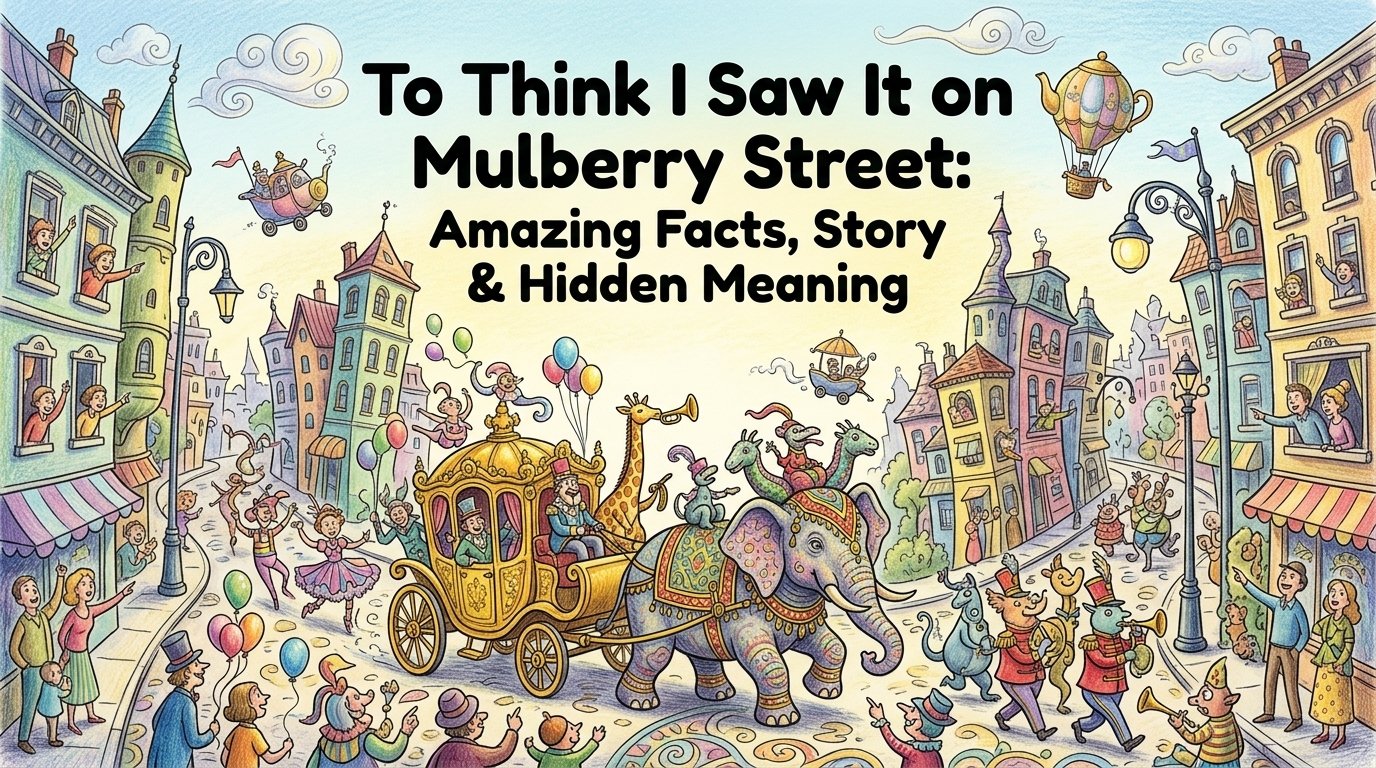
Few children’s books begin with something as ordinary as a child walking home from school and turn it into a wildly imaginative parade. That contrast is at the heart of to think i saw it on mulberry street, better known by its full title, And to Think That I Saw It on Mulberry Street.
Published by Vanguard Press in 1937, it was written and illustrated by Theodor Seuss Geisel (better known as Dr. Seuss), and his first children’s book published under the name Dr. Seuss, marking an important moment in children’s literature history. The story is of a boy, Marco, who, as he walks home, has only seen the one horse and carriage ride to account for his visit, and he is not willing to let that one humble observation stand as reason for a good story told to his father. Marco’s wild imaginative narrative turns that mundane trip home into the ever more fabulous sight of extraordinary creatures, musicians, law enforcers, public officials, and a parade.
More than just a collection of whimsical images and words, the book is about the way kids invent stories from daily events, the way imagination expands from an initial simple thought, and the drive within child experience to create a narrative to surprise an adult. Its publication record and subsequent modern controversy place the work in still another significant context.
What Is And to Think That I Saw It on Mulberry Street About?
In a broad sense, it’s about imagination changing reality.
Marco has walked home from school; his dad has told him to notice what he sees and he has almost nothing to say. The actual episode in Marco’s life when he is walking home has been a horse pulling a wagon down Mulberry street.
That is not exciting enough for Marco.
As he continues walking, the story in To Think I Saw It on Mulberry Street begins changing the details in his mind. The regular horse keeps growing bigger and the wagon becomes a bigger spectacle yet one thing leads to another until your familiar horse and wagon become the middle of a public extravaganza. The evolution of what was to be a commonplace object is a very memorable element and does not feel like an invented outlandish story; it feels like something Marco’s imaginative mind stumbled into.
This is a good way for young readers to grasp the concept of a story: from one ordinary sight, a world of make-believe can materialize. The book published in 1937 is32 pages long (when the books come in the originally manufactured small sized form), and it has come to be regarded as Geisel’s first children’s book using his known pseudonym.
Who Is Marco?
Marco is the central character and the person through whom readers experience the story.
The child in To Think I Saw It on Mulberry Street has a vivid imagination, but he is also concerned about how his experience will sound when he tells it to his father. That question is meaningful because it gives the author’s imagination an agenda; he is not trying to do idle fantasy for the pleasure of daydreaming. Instead, he is constructing in his mind a story he feels is worthwhile sharing.
Marco’s thought process will also be relatable to young readers. A child will recognize the childish urge to exaggerate a mundane event, especially when he’s just been pressed by an adult “What did you do today.”
Instead of simply relating seeing a horse-drawn wagon, he embarks on a fantastic tale; his imaginary vision seems greater and greater. His mind makes it a parade that includes more and more animals and vehicles; then adds to it as each aspect of his image seems… lacking.
But the narrative conclusion always takes him back to what it actually was that he was observing. In this case, only when he comes home and can give the answer (that was pressed from him) ‘What did you see,’ is the big story dispelled. The correct and truthful answer is indeed, a horse drawn carriage.
The humor and emotion, then come from the fact that you, reader, followed all of Marco’s imaginative leaps, and the event at the center of it all was perfectly mundane.
How the Story Builds From Reality to Fantasy
Its brilliant device of escalation-a good one. Marco finds something that is obviously recognizable-and makes a transformation on it and that transformation gives Marco an idea for the next one, so it is constantly spiraling upward, so it only has moved ever so far from something that actually might occur in the street.
The basic progression works like this:
- Marco sees an ordinary horse and wagon.
- He imagines the horse as a more unusual animal.
- The animal becomes increasingly impressive.
- The wagon changes into more elaborate forms.
- Additional people and animals enter the scene.
- Police and city officials become involved.
- The event develops into a grand parade.
- Marco eventually returns home and admits that reality was much simpler.
The sequence matters because each stage demonstrates a different level of creative exaggeration.
For children, this can make the book especially engaging because the story keeps asking a silent question: What could possibly happen next?
The answer is almost always more imaginative than the previous page.
Why Imagination Is the Central Theme
But imagination is not just an ancillary detail within this story–it is a driving force. Marco takes something that already exists and imbues it with fantasy through the application of imagination–he needs not a new topic to begin an imaginative transformation with.
The real world provides material at his disposal, and as a story idea for young readers it proves extremely attractive because children will find out that something they’ve made up doesn’t necessarily have to originate in an unusual setting–child may simply observe a street, a car, a dog, or person and transform a real thing with fantastic ideas from his own mind; he need simply change the idea, by employing imagination to it.
The story also differentiates observation from imagination clearly-observation is only Marco looking at the horse and cart whereas imagination is to create fantastical story from it; none of these processes have to preclude the other, instead imagination flourishes from observation and that perhaps is why the story is also effective in enabling discussion of how to begin an imaginative creative writing venture with any subject by asking a young writer to identify any number of further transformations for simple real things,
What Does the Ending Mean?
The ending is deliberately funny, but it also reveals something about Marco.
After spending the entire walk developing an extraordinary story in To Think I Saw It on Mulberry Street, he reaches home ready to tell his father about what happened. Yet when he is asked what he actually saw, Marco retreats to the truth: it was only a plain horse and wagon.
This ending emphasizes the disparity between the story in Marco’s head, and the reality.
And this ending alsoimplies that Marco knows the difference between his world and the one outside of his head; he’s not totally mistaking what’s in his head as something that has happened, he knowthat he has fabricated his brilliant story. This is important for young readers; as the book is all about fantasy and Imagination, but not making kids lose touch with reality; they can just get lost in their fantasy while they’re on their way home,but once they get there they know that.
The result is playful rather than confusing.
The Origins of the Book
The creation of the book is closely connected to Geisel’s development as a writer and illustrator.
According to accounts of the book’s creation, the rhythm of the engines on a ship returning from Europe helped inspire the rhythmic text in To Think I Saw It on Mulberry Street. Geisel began working with a phrase that eventually developed into the story associated with Mulberry Street. The process took substantial effort, with Geisel revising the work repeatedly.
Difficulty in getting the manuscript published was also a hurdle. Details regarding the publication of the manuscript are varied, but many accounts report that Geisel received countless rejection letters before meeting up with someone whom he happened to be acquainted with who by then, was a juvenile editor with Vanguard Press, who then decided to accept the manuscript for publication, in 1937.
This particular story has interest because a book that became an outstanding classic in children’s books took its share of difficulties in being accepted for publication.
The eventual impact of the story, however set the groundwork and stage, for the characteristics which defined the Dr. Seuss way of writing; this involves rhyme, larger than life visual concepts, odd characters, an interconnection of story and illustration.
Where Did Mulberry Street Come From?
The choice of “Mulberry Street” has ties to Geisel’s native Springfield, Massachusetts.
There was indeed a real street in Springfield (the city where Geisel grew up), called Mulberry Street, which has been subsequently referenced in scholarship as perhaps being drawn to Geisel because of its position on the maps it did learn on and the fact of its location and that it corresponded with parts of his early imagined environment.
But it’s definitely less clear exactly how “Mulberry Street” was derived and more clear it was drawn from his childhood imagination rooted in his particular hometown.
That brings another piece of the book into context.
Even though Marco’s street transformed into a mythical place, the original basis of it in a real American town also resonates with the structure of the entire story. As it turns out, what reality gives to the tale-the foundation of it-and imagination sends us to new and heretofore unheard of places. It seems a particularly astute choice for a story concerned with reinterpreting his environment as pure fiction.
The Importance of the Illustrations
These illustrations are very important to the book because Geisel was both its author and its illustrator. The visual development helps the reader to follow Marco’s imaginary world without having to just imagine how much the world around Marco has change based on only words, highlighting the role of illustrations in children’s books. The illustrations gradually increase the enormity and ridiculousness of Marco’s imagination.
This rhythmic word structure combined with fantastical illustrations developed the characteristic Dr.

Seuss writing and drawing style. These illustrations not only make the imaginative part of the book easier for a child to understand but they teach sequencing as well; a child can look at one picture of the imagination and then at the next and really see how that very tiny picture could get to that much larger and altered of a version and at one same time a child can simply find the silliness and change utterly amusing and a grown-up can view this transformation as how creatively, something can be escalated beyond reason; the possibilities are multiple interpretations of the same words and picture.
What Makes the Book Different From a Simple Fantasy Story?
Though it is easy to simply call it a fantasy, that is a rather poor descriptor.
The novel doesn’t start in a fantastical world. Marco starts off with the average boy’s existence.
No monsters are in waiting at the inception of the novel, instead; Marco conjures up his monsters.
This is precisely where the fantasy deviates from tradition. Usually the protagonist finds himself in a world that has a fantastical set, rather than bringing the world into existence himself.
This sets up the novels relation to imagination so well. We see how Marco begins to transform an ordinary world into something grand.
This transformation feels more like improvisation where one idea breeds the next with exponentially greater stakes.
The Book’s Historical Significance
In Children’s Lit history, the book holds importance because it is Geisel’s very first children’s book published under the Dr. Seuss title. Published by Vanguard Press in 1937, it helped set the groundwork for the whimsical direction of his career.
Later Dr.
Seuss books were published and became far more popular, namely, The Cat in the Hat, Green Eggs and Ham, and How the Grinch Stole Christmas!, but Mulberry Street came many years prior. Therefore interested readers study the work with care as an early manifestation of themes and strategies that the Dr. Seuss of later years would master; the insistent rhythm, outlandish depictions, humorous overstatement, and the significant role the illustrations played in the story. The books also featured for the first time, Marco, a boy who would reemerge in McElligot’s Pool.
Why Was the Book Removed From Publication?
Certainly the recent history of the book is much more convoluted than its literary significance.
In March of 2021 Dr. Seuss Enterprises announced the decision to publish and offer no further copies of six Dr.Seuss books, including And to Think That I Saw It on Mulberry Street. The organization determined that the books contained racist pictures which are inappropriate, racist and wrong.
This news sparked a considerable public conversation about children’s literature that predates the existence of most of us, the question of whether to preserve books containing certain imagery and, the role of historical context.
Regarding Mulberry Street, the issue is an image of an Asian person rendered in a dated stereotype. Reporting at the time cited the offensive picture as one of the reasons for the book’s discontinuation.
This hardly renders the book obsolete, but its relationship to us is complicated going forward.
A reasonable argument can simultaneously acknowledge that the tale contains ingenious exploration of children’s thoughts and a good deal of the book has been images rooted in outdated and offensive stereotypes.
This consideration is especially important for parents, educators, librarians and anyone aiming to engage youngsters of school-age with these more “aged” picturebooks.
Common Misunderstandings About the Story
Marco Is Not Actually Seeing the Parade
The most important distinction is between what Marco observes and what he imagines.
The parade is part of his mental story rather than a literal event taking place on Mulberry Street.
The Book Is Not Simply About Lying
Marco does exaggerate what he has seen, but the story is more interested in imagination than in teaching a simple lesson about dishonesty.
His invented version is presented as a creative construction. The ending makes clear that he knows the difference between the fantasy and the real event.
The Street Is Not the Main Character
Despite its prominent place in the title, Mulberry Street mainly functions as the setting from which Marco’s imagination takes off.
The real focus is Marco’s transformation of an ordinary observation into an extraordinary narrative.
How Parents and Teachers Can Use the Story
The book can provide an effective starting point for creative activities, particularly when children are encouraged to distinguish fact from imagination.
One simple activity is to ask a child to observe an ordinary object—a bicycle, parked car, tree, dog, or delivery truck—and create three increasingly imaginative versions of what they see.
For example, a child might begin with:
Reality: A truck is parked outside.
Then:
Imagination: The truck is carrying a secret laboratory.
And finally:
Fantasy: The laboratory is traveling around the world searching for a lost invention.
The exercise mirrors the basic creative mechanism used by Marco.
Another interesting exercise is to request them to narrate the same situation twice-the first time as it occurred, and second time as the same scene rendered from an imagination based narrative. This would thereby guide them about two distinctive channels of verbal expression; one that is fact based observations and the second, purely from the frame of a fictional narrative. For older children this book could further be used for engaging the students in talks on how pictures contribute towards the writing as well as how old classic children books should be approached within their respective historical paradigms.
Common Mistakes When Interpreting the Book
A first mistake would be only reacting to the craziness of the pictures and therefore neglecting the narrative structure behind it.
The text develops by an escalation. With every fantasizing event new ones have the chance to develop themselves and acknowledging the way progression unfolds makes the book as exciting as it is otherwise, although the pictures should obviously be seen more critically.
A second fault might be to take Marco’s imaginations literally. Only with the help of acknowledging the distinction between his fantasizing and actual perception of reality this story’s message is understandable in its ending.
A third mistake would be analyzing the literary impact of this picture book while ignoring and thus validating the pictures’ offendingness. One can certainly admire the historical consequence of this work while simultaneously acknowledging criticism.
Discourse needn’t operate on a single interpretation level.
Is It Still Worth Reading?
That depends on the reader and the context.
Historically, a Seuss scholar, that could still be a historical record of his literary achievements as a picture book writer under this popular nom de plume; for a teacher or educator, Seuss’s handling of imagination, observation, exaggeration and storytelling, is still worthwhile information for a lesson. The readers must also consider that this book was taken out of circulation in 2021 for its “harmful imagery,” as per Dr. Seuss Enterprises’ decision.
Therefore, it is more appropriate to discuss its literary impact in an appropriate, contextualized way, instead of discussing the whole work as something eternally appropriate and relevant.
Its literary significance and offensive parts can be discussed together.
Final Takeaway
To think i saw it on mulberry street remains notable because it captures a simple but powerful idea: an ordinary observation can become the beginning of an extraordinary story. Sees horses and a wagon; later uses his imagination to transform that simple moment into an amazing parade. First children’s book to be published under his new pseudonym, Dr. Seuss in 1937, the book established several key storytelling elements that would go on to inform his later works.
It’s got a controversial history — in 2021, some imagery contained in the book had Dr.
Seuss Enterprises cease its publication, and while this history needs to be taken into consideration, it’s still a fantastic example of how visual perception combined with exaggeration, rhyme, and imagery can create literature from everyday experience.
FAQs
1.What is And to Think That I Saw It on Mulberry Street about?
The story follows Marco, a boy walking home from school who sees an ordinary horse and wagon on Mulberry Street. Instead of accepting that simple observation, he uses his imagination to turn it into an increasingly elaborate parade filled with unusual animals, vehicles, musicians, and officials.
2.Who wrote And to Think That I Saw It on Mulberry Street?
The book was written and illustrated by Theodor Seuss Geisel, better known as Dr. Seuss. First published by Vanguard Press in 1937, it was his first children’s book published under the name Dr. Seuss.
3.What is the main theme of the book?
The central theme is imagination and creative storytelling, which makes it especially relevant to creative writing for children. Marco starts with an ordinary experience and continually expands it in his mind. The story also explores the difference between what a person actually observes and what they can invent through imagination.
4.What does Marco actually see on Mulberry Street?
Marco actually sees a plain horse and wagon. Everything that follows—the unusual animals, elaborate vehicles, musicians, police escorts, and grand parade—is part of the story he creates in his imagination before returning home.
5.Why is Mulberry Street important to Dr. Seuss?
The street is believed to have been inspired by a real Mulberry Street in Springfield, Massachusetts, where Geisel grew up. The familiar setting fits the story’s central idea because an ordinary place becomes extraordinary through Marco’s imagination.
6.Why was the book withdrawn from publication?
In March 2021, Dr. Seuss Enterprises announced that it would stop publishing the book along with five other Dr. Seuss titles because of images it considered harmful and inappropriate. The book contains historical racial stereotypes that have drawn criticism from modern readers and educators.
7.Is And to Think That I Saw It on Mulberry Street still important today?
Yes, particularly from a literary and historical perspective. It introduced many elements associated with Dr. Seuss’s later work, including rhythmic language, visual exaggeration, imaginative storytelling, and playful transformations of ordinary situations. At the same time, its problematic imagery should be acknowledged when discussing the book today.
Conclusion
To think i saw it on mulberry street remains an important early Dr. Seuss work because it shows how a simple observation can become an entire imaginative adventure. Starting with nothing more than a horse and wagon, Marco’s talent for imagination converts the plainest circumstances into a grand parade. The book, originally published in 1937, also laid the ground for Dr. Seuss’ later signature literary and visual style.
In terms of its place in children’s literature, this books also requires some historical perspective: it also includes stereotypical images in ways that caused Dr.
Seuss Enterprises to cease publishing it in 2011. The book’s most useful function to contemporary readers today may lie in learning about it on one level, and also using it to explore critical perspectives on earlier media.








