

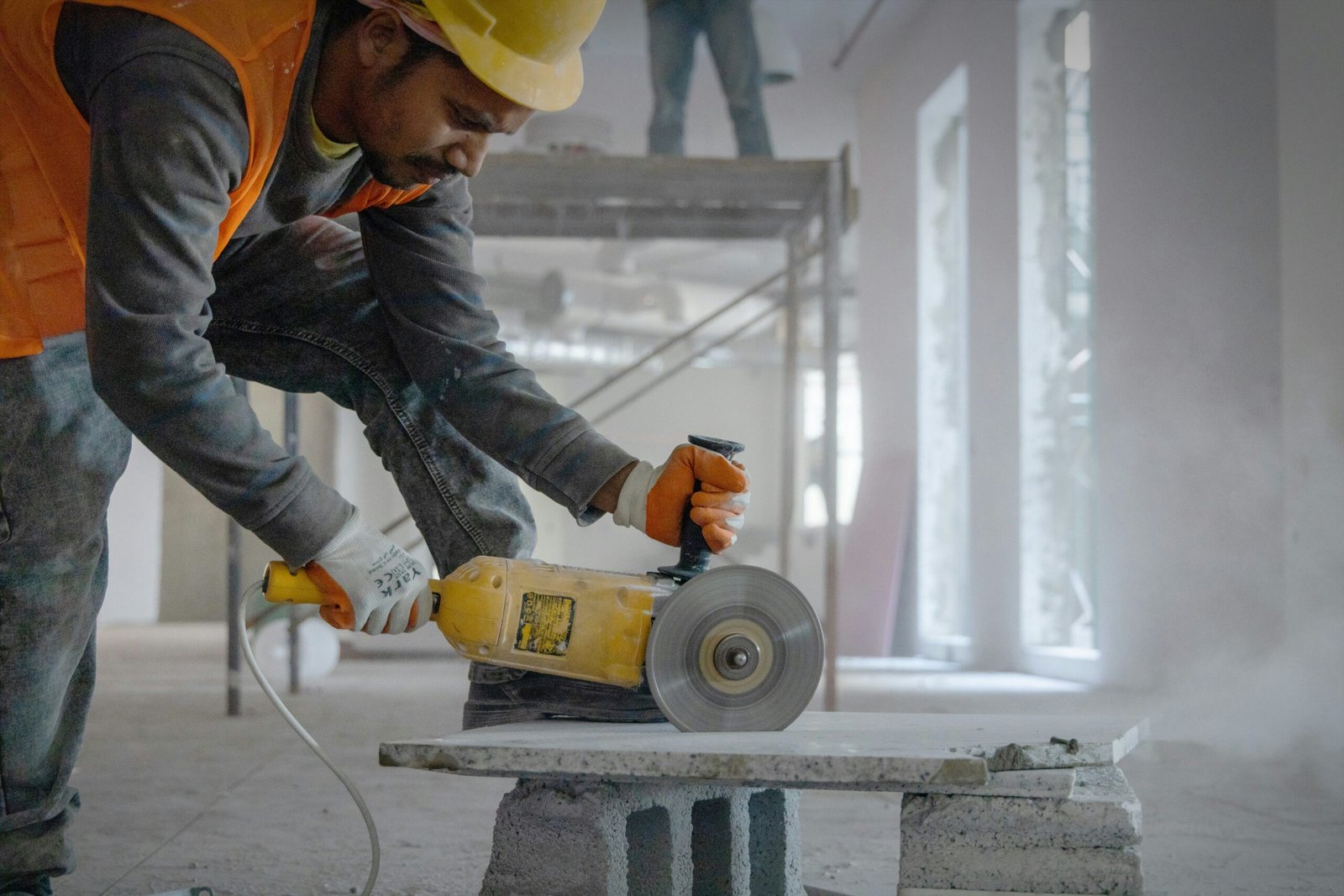
Silica, once considered a background hazard on most Australian sites, is fast becoming a highly regulated substance, equal to asbestos. The prohibition of use of many engineered stones, the lowering of the Workplace Exposure Standard for silica dust from 50 μg/m3 to 50 μg/m3 as an 8hr TWA, the introduction of ‘prohibition notices’ for uncontrolled dry cutting tasks and the consequent high level of interest from both health and safety personnel and workplace inspectors, all mean that being able to provide evidence of the level of exposure on any given day, and that the controls in place are working, are major challenges facing most sites today.
We explore the top 5 things to know about silica, the tasks that create the highest silica-exposure, and outline strategies to create silica-dust risk-assessments that add real value to your workplace health and safety compliance.
Where exposure actually concentrates
Silica content can vary quite significantly in different materials. By ranking tasks based on the silica content of the material being worked with, attention can be focused on the higher silica content materials. Sandstone and quartzite can contain up to 90% or more crystalline silica. Concrete and mortar typically contain between 25% and 70% crystalline silica. Bricks, tiles and some natural stones can contain a broad range of silica content. It is the energy released from a particular task or process that generates respirable particles, and this needs to be considered when ranking tasks for silica control.
The risk of high-energy dry processes can quickly overwhelm general ventilation in producing respirable size particles. Those tasks need to be looked at closely.
- Dry cutting, grinding or chasing of concrete, masonry and pavers with abrasive wheels
- Jackhammering, scabbling and surface preparation before coatings
- Tunnelling and rock drilling, particularly in confined headings
- Abrasive blasting with silica-containing media or on silica-bearing substrates
- Dry sweeping and compressed air clean-down, which re-entrains settled dust
- Bag tipping and silo loading of cementitious powders and foundry sand
Secondary exposure is routinely underestimated
The person most exposed to silica dust is not always the person cutting materials. Labourers, cleaners, maintenance staff and others who work near sanders, cutters and breakers, as well as their supervisors, can receive large exposure doses. In addition, people who clean up sawing and cutting materials, who wear contaminated clothing, and who work with vacuum filters, cleaning vacuum filters and hoses, can receive large doses of silica dust over a long period.
Choosing engineering controls that hold up
In order of preference for controlling silica exposure from cutting tasks, the options for substitution would include use of lower silica-containing products or even pre-cut materials (to prevent any cutting at all). Water suppression and on-tool extraction systems would be the most cost effective of the engineered controls for tasks that cannot be substituted.
| Control | Best suited to | Key limitation | What to verify |
| Integrated water suppression | Floor saws, core drilling, masonry saws, road cutting | Slurry management, electrical risk, cold and indoor settings | Flow rate at the blade, not just tank volume |
| On-tool local exhaust (H-class) | Angle grinders, chasers, handheld drilling, indoor work | Shroud fit and hose length reduce capture | Filter condition, airflow indicator, correct shroud for the wheel |
| Enclosure and isolation | Fixed processing, blasting, bag tipping | Capital cost, restricts access | Negative pressure, interlocks, extraction balance |
| Wet cleaning and H-class vacuums | All post-task clean-up | Discipline drops under time pressure | No brooms or compressed air available on site |
Maintenance is the control, not the equipment
Dust extractors can become ‘dead weight’ on a tool if a filter becomes loaded whilst in use. Ensure that extraction units are included in the plant maintenance schedule with specified filter change intervals. It is also important to complete a pre-start check list that includes the correct connection of hoses, checks the condition of the shroud and checks that there is water flowing to the tool.
Respiratory protection as the last layer
In some cases, engineering controls will not reduce exposure to within the acceptable exposure standard. Where exposure cannot be reduced to an acceptable level by use of control measures, Respiratory Protection (RP) must be implemented and managed with similar rigour to other control measures for silica.
- Assign a required minimum protection factor based on expected exposure against the 0.05 mg/m³ standard.
- Quantitatively fit test every wearer of a tight-fitting respirator, and retest annually or after significant facial change.
- Enforce a clean-shaven policy for tight-fitting devices, or move to a loose-fitting powered air-purifying respirator.
- Store, clean and inspect reusable respirators under a documented program rather than leaving it to individuals.
Proving the controls work
Personal sampling of silica dust over a representative work shift and analysing the results against the relevant WES provides definitive proof of what actually is getting into the lungs of workers. Bringing in a qualified hygienist to plan and carry out silica dust monitoring is the most reliable way for site management to determine which of the various control measures are effective and which are not.
Building a useful sampling cycle
Sample within similar exposure groups (eg stone sawers, tile fillers, concrete finishers). Repeat sampling within a group periodically to quantify change in exposure resulting from new material, process, tooling, work method, identified control failure or change in worker health identified through health monitoring. Results communicated within days to supervisors and to individuals who have been sampled, with explanation of required control changes.
Health monitoring for silicosis, including where appropriate low-dose HRCT scanning, should be conducted in addition to air monitoring of silica dust levels. While air monitoring confirms whether a workplace is controlled for silica, health monitoring confirms whether the control was implemented in time to be of benefit.








