

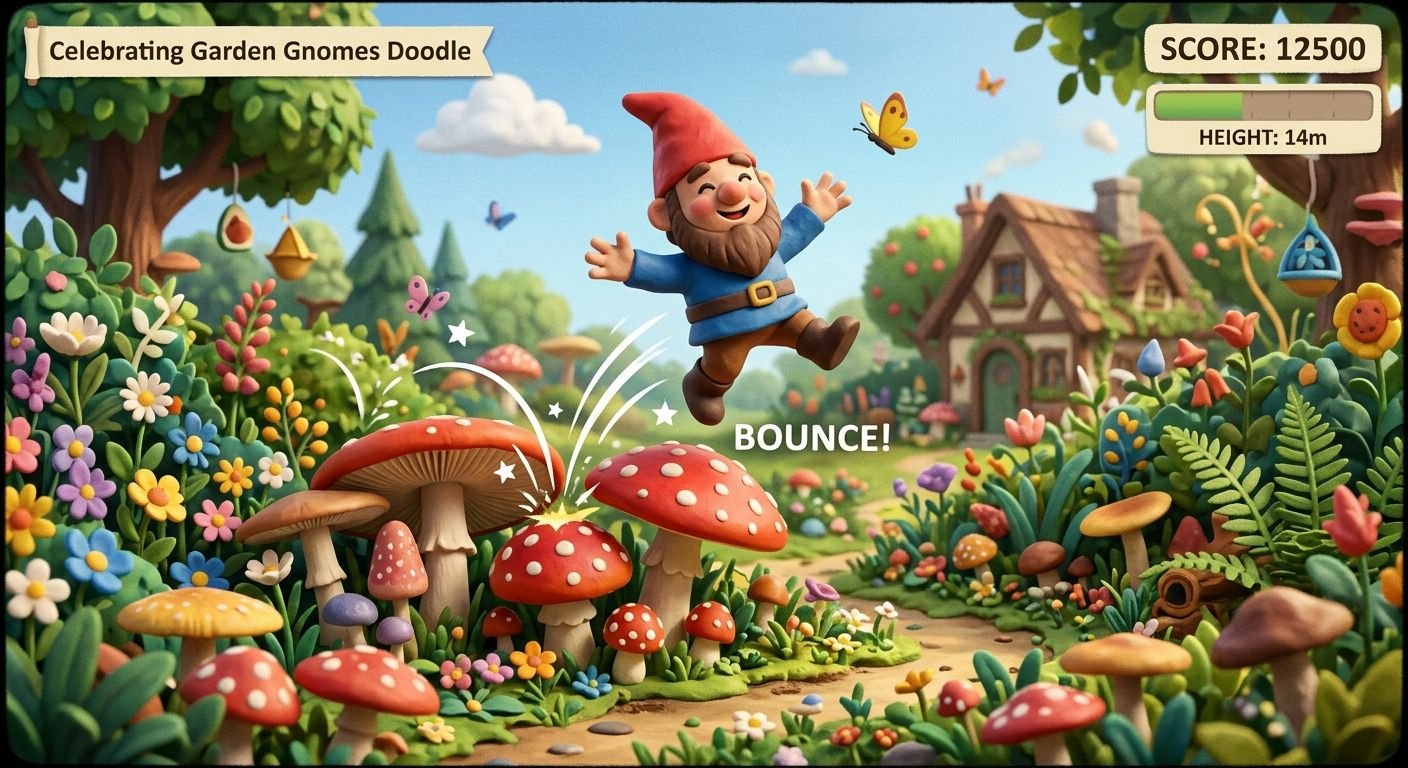
Are you trying to find the garden gnome game?Then you’re in the right place.Those of you who found this page looking for the Google’s garden gnome doodle should check out the beautiful animated, adorable, and simple Google garden gnome game, where you aim to send your clay gnome flying into the garden as far as possible, planting more flowers while you do.
What is the History of the Google Gnome Doodle? Google first published the Gnome Doodle for an interactive fun on June 10, 2018, to celebrate the Gnome and its German gardens. The game functions as a trebuchet-style launcher that allows six vibrant gnomes to be played with varied shapes, weights, and bounce attributes.
What is remarkable about the garden gnome game is that you don’t just push a button to make a funny guy fly through the air. There are timings, gnome choices, bouncing and objects to interact with in the garden.
In this guide you will learn what it is, how to play it, what the gnomes do, what the garden setting entails and how to increase your distance.
What Is the Garden Gnome Game?
The garden gnome game, but the official title of the Google Celebrating Garden Gnomes interactive Doodle is…
Google Doodle for Garden Day in Germany Google developed the Doodle, which was published in celebration of Garden Day in Germany, with the help of Jessica Marinkovits and Mysterious Trousers. The Doodle is a mini cultural lesson and a clay gnome throwing game where you have to operate a trebuchet to shoot gnomes in a garden.
Google’s official Doodle page also notes that the modern garden gnome was first produced in 19th century Germany, within the area of Thuringia’s mining industry. While gnomes had existed elsewhere in Europe and Anatolia, the style that we think of as a ‘garden gnome’ became a phenomenon of Germany.
Quick facts about the game
| Feature | Details |
| Official Doodle | Celebrating Garden Gnomes |
| Original launch | June 10, 2018 |
| Main theme | Garden gnomes and German garden culture |
| Main mechanic | Launch a clay gnome with a trebuchet |
| Objective | Travel as far as possible |
| Scoring | Greater distance produces more flowers and points |
| Gnome choices | Six |
| Gameplay style | Simple physics-based launch game |
The original Doodle is part of Google’s broader collection of interactive Doodles, which includes games, animations, and other interactive experiences.
Is the Garden Gnome Game Still Available?
Google has an official Celebrating Garden Gnomes Doodle archive page. So, the best place to find out is Google’s Doodle archive and not some random website that happens to have a similar name.
And also this May 1, 2020 Google doodle when the Garden Gnomes game was featured in Google’s “Stay and Play at Home with Popular Past Google Doodles” series. This verifies that Google has deliberately kept the game in its archive of past interactive Doodles.
Availability varies depending on how the archived Doodle is being viewed, but this makes it worth comparing the official Google Doodle archive with unmoderated Google Doodle pages and those found directly on our homepage.
For a PC garden gnome game, a Google Doodle version is the most notable, as it was intended as a browser-based interactive experience and not a traditional PC game that runs a desktop application.
How to Play the Garden Gnome Game
The basic gameplay is easy to understand, but getting a good result requires some experimentation.
1. Start the game
Access the interactive Garden Gnomes Doodle from the official Google Doodle archive after it goes live.
The game start with an intro to the theme of garden gnomes before playing the game. Google thought the experience of Garden Gnome Village would be about the gnome’s culture as well as the game itself.
2. Choose a gnome
You can choose from six colorful gnomes.
They are not identical. Google says they have different shapes, weights, and bounciness, so experimenting with them is part of the intended gameplay.
3. Launch the gnome
The gnome is placed into a trebuchet-like launcher.
Your objective is to release it so that it travels as far as possible through the garden.
4. Watch the trajectory
After being fired, the gnome flies through the space and will interact with elements around it.
Physics are one of the main fun factors. Google features mushroom bouncing, cloud skimming, and some butterflies that make the gnome fly higher.
5. Check your result
The distance traveled determines how much progress you make toward decorating the garden with flowers and earning points.
Then you can try again with a different timing approach or another gnome.
Garden Gnome Game Controls
The key control is the user interaction for activating the trebuchet and releasing it. It’s more reliable to double-check your own version of the controls, rather than assuming all third-party copies are the same, because the implementation of Browsers and archived versions can vary.
Original experience of a PC garden gnome game was based on simple web browser clicking instead of a complicated keyboard layout.
So the key skill is not to memorize a complex control scheme but to get used to to letting gnome go.
Note: If you are on a version that works with a touchscreen the UI might be different for the launch interaction. Once again, go by the controls given by that specific version, rather than assume an unofficial version works exactly like Google’s.
How the Garden Gnome Game Mechanics Work
The garden gnome game becomes more interesting once you understand its basic physics.
The gameplay loop can be simplified to:
Choose a gnome → launch → travel → interact with the environment → land or bounce → measure distance → repeat.
The trebuchet
The catalyst that propels the gnome into the garden is the trebuchet.
The launch determines the initial course of travel so in this case, timing is key. If we tweak the timing slightly, the gnome will go to different places with different possibilities.
Distance
Distance is the main performance measurement.
– pointing out that spreading out the gnome requires planting more flowers and, therefore, scores more points.
That makes distance more practical goal for targeting than just throwing the gnome willy-nilly.
Bouncing
The gnome will not necessarily behave just like launch-and-land.
Things out there in the world can also influence its motion. Google specifically mentions a mushroom bounce as one of the physics interactions in the game.
This also means that a successful run will also heavily rely on what occurs after the initial launch.
Clouds and butterflies
Google’s behind-the-Doodle content is also on hand to see cloud skimming and the butterflies that can elevate the gnome.
This information helps to make sense of why the garden is not simply a background in the game. The environment is partly brought into play through the movement system.
The Six Garden Gnomes Explained
One of the most useful features of the garden gnome game is the choice between six different gnomes.
Google describes them as having different shapes, weights, and bounciness.
Rather than assuming that one character is automatically the best, think of each gnome as a different physics experiment.
| Character characteristic | Why it matters |
| Shape | Can influence how the gnome behaves during movement and contact |
| Weight | Changes how the launch feels and how the character interacts with the environment |
| Bounciness | Can affect what happens after hitting certain objects |
| Overall design | Gives players another reason to experiment with different options |
The official Google description actually encourages players to try each gnome and see which one produces the greatest distance.
That is a better approach than treating online claims about a universally “best” gnome as established fact.
What Do Mushrooms, Clouds, and Butterflies Do?
Environmental objects are one of the areas where the garden gnome game offers more depth than its simple controls suggest.
Mushrooms
Mushrooms can provide a bounce that changes the gnome’s movement.
Google’s own behind-the-scenes material labels this interaction “Mushroom bounce!”, confirming it as an officially documented gameplay feature rather than simply a theory developed by players.
Clouds
Clouds can be skimmed during a run.
This creates another way for the gnome’s trajectory to interact with the environment. Google’s behind-the-Doodle material specifically demonstrates cloud skimming.
Butterflies
Butterflies can take the gnome higher.
This is another example of how the game’s environment can influence the outcome after the initial launch.
What about logs and other objects?
Some third-party guides also mention other interactions with the environment. However, not all claims regarding the physics have been verified with first-party sources.
To ensure the coverage is precise, it is recommended to separate the learned mechanics that Google explicitly shows from any of these refinements that individual players notice.
How to Get More Distance in the Garden Gnome Game
There is no need for a complicated strategy guide to start improving. Focus on a few repeatable principles.
Improve your release timing
The initial launch determines the starting trajectory.
Instead of changing everything after every attempt, make small adjustments to your timing and observe how the result changes.
Experiment with multiple gnomes
Because the six gnomes have different characteristics, testing several of them can teach you which behaviors work best with your playing style and the situations you encounter.
Learn the garden’s physics
Don’t think of mushrooms, clouds, butterflies, and other elements as background decoration.
Some can affect movement, so recognizing them can help you understand why one run travels farther than another.
Study what happens after the launch
A common beginner mistake is focusing only on the trebuchet.
The launch is only the beginning. What happens afterward can determine whether the gnome continues traveling or loses momentum.
Change one thing at a time
If you change the gnome, timing, and approach simultaneously, it becomes difficult to understand what actually improved your result.
Instead, test one variable at a time.
For example, use the same gnome for several attempts while changing only your release timing. Then switch gnomes and compare the results.
Garden Gnome Game Tips for Beginners
If you’re playing for the first time, keep the strategy simple.
First, learn the controls. Don’t worry about achieving a long distance immediately.
Second, test more than one gnome. Their differences are part of the game’s design.
Third, watch your surroundings. Mushrooms, clouds, and butterflies can influence the gnome’s movement.
Fourth, pay attention to timing. The same gnome can produce different results when launched differently.
Finally, treat each attempt as information. If a launch performs poorly, identify what happened instead of simply repeating it unchanged.
Advanced Garden Gnome Game Strategy
Once the basic controls feel familiar, you can start thinking more systematically.
Instead of asking, “Which gnome is best?” ask:
Which combination of gnome characteristics and launch timing produces the result I want?
That approach is more useful because the game is built around experimentation.
You can also compare attempts by recording:
- Gnome used
- Approximate launch timing
- Environmental interactions
- Final distance
- Resulting points
This makes successive retries as easy as a simple test.
For example, if Gnome A always makes it farther in the first few trials, do not jump to the conclusion that he is better than the others. Use the same launch conditions on another gnome.
Common Garden Gnome Game Mistakes
Releasing without paying attention to timing
Random launches make it difficult to improve.
Using only one gnome
You may be ignoring one of the game’s central mechanics.
Ignoring environmental interactions
Mushrooms, clouds, and butterflies are part of the game’s physics system.
Changing everything at once
If you switch gnomes and timing simultaneously, you won’t know which change affected the outcome.
Trusting every third-party claim
A few sites list strategies, exploits, or “best” characters without telling where those rankings originate.
When it comes to factual questions about the Doodle itself, Google’s official archive and behind the Doodle information are more reliable.
Garden Gnome Game vs Other Gnome Games
Garden gnome game can mean different things online.
Some pages mention the term with respect to Google’s Doodle, while others references garden gnomes as characters or objects in entirely different games.
For instance, a garden gnome in a game like Fallout 76 is not the same as Google’s Garden Gnomes Doodle.
Similarly, the website with the Google Doodle games is a compilation of different games and are not the official Garden Gnomes Doodle.
What to look for in the original experience To find the Google Doodles archive, search for the title Celebrating Garden Gnomes. Google’s archive will show which Doodle it is and when it was first released.
The History Behind Google’s Garden Gnome Game
It’s the historic aspect of the garden gnome game that makes this Doodle out of your everyday browser game.
The Google Doodle was inspired by the occasion Garden Day in Germany and the cultural history of garden sculpture.
The search giant’s research into its Doodle says, The typical garden gnome originated in 19th-century Germany, with the craft of making them originating in the state of Thuringia. As the designer’s notes continues: Gnome figures have a much longer history elsewhere.
They provided this historical context as an introductory presentation leading up to the game.
Google Doodler content from behind-the-scenes reveals that the team also looked into many gnome types and hairstyles and clothing styles and garden plants and building styles and silly poses while designing the Doodle.
The game’s physics, likewise, had been intentionally crafted and tested, according to Google’s notes on development. These include mushroom bouncing, cloud skimming and the gnome being carried by the butterfly.
Why the Garden Gnome Game Is So Easy to Pick Up
The basic concept requires very little explanation:
Launch a gnome and try to send it farther.
This simplicity provides an immediately apparent learning curve. A new player immediately knows what they need to do, and they get to learn more and more what they need to do with each subsequent try.
This six- gome choice also brings experimentation into the mix without a complicated inventory and progression system. Google purposely made the characters all different shapes, weights, and bounciness, so people would play around with them.
That combination makes the garden gnome game a good example of how a short interactive Doodle can combine cultural education with simple game mechanics.
Frequently Asked Questions
1.What is the Garden Gnome Game?
The Garden Gnome Game often actually means Google’s Celebrating Garden Gnomes interactive Doodle from 2018. The game involves players throwing clay gnomes into a virtual garden and attempting to get the highest distance, flowers, and scoring.
2.Is the Garden Gnome Game a Google Doodle?
Yes. Google created Celebrating Garden Gnomes as an interactive Doodle celebrating garden gnomes and Garden Day in Germany. It launched on June 10, 2018.
3.How do you play the Garden Gnome Game?
You choose one of six gnomes, use the trebuchet-style launcher, time the release, and try to send the gnome as far into the garden as possible. Environmental elements can affect the gnome’s movement.
4.How many gnomes are in the game?
Google’s original Doodle provides six colorful gnomes. They differ in characteristics including shape, weight, and bounciness.
5.What do mushrooms do in the Garden Gnome Game?
Mushrooms can bounce the gnome and change its movement. Google specifically demonstrates the mushroom-bounce mechanic in its behind-the-Doodle material.
6.Can I play the Garden Gnome Game on a PC?
For the original Doodle, which was a computer game you played through your web browser, this is also relevant to the keyword searches garden gnome game PC experience. The safest location to find the original Doodle is via Google’s Doodle collection rather than an unrelated downloadable game.
7.Is the original Garden Gnome Game still available?
Google has a Garden Gnomes Doodle archive page, and it was featured in Google’s 2020 roundup of the most popular interactive Doodles of the year. Sometimes, the game works in a specific archived environment. For the sake of accuracy, Google’s official archive is the best source for the original game.
Conclusion
The garden gnome game is a lot more than just a launch animation. Celebrating garden gnomes is a minimalistic physics game built on the history of garden-gnomes in Germany, as well as timing, distance, testing, and the natural environment.
The best way to approach it is to first learn the launch, test the six gnomes, and then really notice how mushrooms, clouds, butterflies, and more influence each run. Yep, Google says as much in their own documentation.
To get the authentic garden gnome game, check out Google’s official Doodle archive, and be sure to search for Celebrating Garden Gnomes, not just garden gnome game as other fakes can turn up in your searches.








