


When a cork is stuck, a task as easy as opening a bottle of wine can turn into a surprisingly infuriating problem, especially if you realize you don’t own a wine key. Luckily there are several ways to remove a cork, and the best one will depend on the circumstances – namely whether the cork is intact, crumbling, pushed inside the bottle, or merely hard to grab. If possible, use a traditional corkscrew, as it is typically the safest bet.
Even without one, there are still reasonable ways to get the job done.
Keep in mind, not only do you want to remove the cork, but you also want to avoid breaking the wine bottle, introducing cork into the wine, and injuring yourself in the process. Luckily, here you’ll find the best practical removal strategies, explanations for why they work, which home remedies actually stand a chance, and some common tricks you’d probably best stay away from.
What Makes a Wine Cork Difficult to Remove?
A wine cork creates a vacuum seal in the bottle neck, which helps protect the wine from outside contaminants and air, making proper wine bottle storage and careful opening important for preserving the bottle’s condition.
The condition of the cork can be particularly influential. A fresher, firmer cork is easier for a corkscrew to catch and bite into. Older natural corks, by the time they begin to deteriorate in older wines, can become desiccated and brittle, making the cork screw susceptible to disintegrating them as it drives into the them. For the same reason, synthetic corks act differently from natural cork; They are typically more elastic, resistant to ripping.
How the bottle has been stored can contribute to the cork as well; wine bottles have traditionally been stored on their side, a practice which helps ensure that a natural cork remains moist. A bottle that has been for a prolonged period in the wrong conditions could contain a brittle, swollen or deteriorated cork.
Similarly, what condition the bottle neck is in will have some effect. If a bottle has dried goo around it or has a worn out rim, or if a cork sitting unevenly within an opening.
Prior to deciding a technique, take a moment and look at the bottle. Such assessment for seconds of observation should avoid brute force.
The Best Method: Use a Corkscrew
Corkscrew If you have an opener nearby, use it. An expertly constructed corkscrew offers more torque to help you pull the cork up evenly.
Remove the foil or capsule that covers the top of the bottle. Wipe the mouth of the bottle down as necessary so that you can see the cork accurately.
Insert the point of the opener into the center of the cork. This tip is more important than it appears. If the screw slips to the outside perimeter, there is an increased possibility that you will split or damage the cork with your attempt. In the center, the force will be applied more evenly.
Slowly turn the screw downward in the cork, applying firm pressure as you go. Drive the screw until it has a good depth into the cork to firmly hold it but do not push it all of the way through the cork as this can push cork debris into the bottle.
With the screw firmly in place, use the opener to slowly pull up on the cork.
If it doesn’t come readily, do not yank on the cork with great force. You might break off the cork or lose grip on the bottle as it attempts to pull upward on you.
For a very old cork, slow pull may be more beneficial than a firm one. If you believe that the cork is about to crack, remove the opener then re- insert it at another angle instead of pulling with more strength.
How to Get a Cork Out of a Wine Bottle Without a Corkscrew
Sometimes the bottle is ready to open but the opener is nowhere to be found. Several alternatives can work, although they generally provide less control than a proper corkscrew.
Use a sturdy screw and pliers
A relatively good last resort, though, is to replicate the fundamental movement of a cork screw. Take a long, reasonably strong screw and a pair of pliers.
The screw should have a large head and be long enough for it to go through most of the cork but not the whole way. It should then be twisted into the center of the cork. Make sure to keep a good amount of screw head sticking out so that the pliers can get a purchase on the head.
When the screw is in, use the pliers to clamp onto the head. Lift slowly while using the other hand to hold the bottle firmly on the table or floor.
This generally works because the screw offers purchase on the cork and the pliers then have leverage to lift it out.
Make sure that you go slowly, as if the screw is starting to tear the cork free of itself, then push it in a bit more, or try it from a slightly different place.
Use a key carefully
Sometimes a strong key will work against a tight cork, but it can be difficult to control compared to an opener. Try inserting the key into the cork at a slight angle, rather than straight down. You need enough of the key to engage the cork that turning will also help pull it out of the bottle neck.
Slowly, turn the key, gently pulling upwards.
Try to work it out of the bottle and avoid pulling directly up in one motion. This is probably better suited for a tightly-in, strong cork than a brittle one – the key might just crumble it rather than pull it out if the cork is brittle. As with many slippery corks, be careful of keeping your hand away from the mouth of the bottle and apply as little force as possible.
Can You Push the Cork Into the Bottle?
Indeed, it is. It would serve as a rather unconventional but feasible alternative solution once all other options seem to be failing.
In order to do this, you could employ any rigid, relatively broad instrument with a rounded end which will fit snuggly onto the surface of the cork but be more or less in line with the diameter of the neck, and therefore force no extra or undue strain on any potentially weaker areas of the cork.
Hold the bottle still on a firm flat surface and push it downwards evenly and gently. Once the cork goes down you could then pour out the wine through a sieve or strainer, provided any crumbs that have occurred can be sieved out. It’s obviously less than ideal as all that really happens is that the cork then sits in the wine and you push it down thus possibly causing a small spray of wine as it goes, not a particularly graceful action, and perhaps causing something of a burden upon the pourer at the next stage.
What to Do if the Cork Starts Crumbling
A degraded cork needs a different approach to a stuck but still intact one. Pushing a conventional corkscrew further into an already crumbling cork can actually produce more bits.
In the case of a decaying cork, you can attempt to insert the corkscrew deeper, focusing on what appears to be the strongest part, and pulling the cork out very slowly whilst keeping the bottle as vertical as possible.
For truly frail natural cork, a pronged corkscrew is invaluable, as it levers against the existing cork in the bottle rather than screwing deeply into it. Simply insert the two prongs between the cork and the bottle neck and draw the cork out with steady pressure.
In the event that small pieces of cork have fallen in, don’t panic; though unwelcome, they aren’t actually very difficult to remove. Pour the wine into a clean, very fine-mesh sieve set over a decanter.
Much more threatening would be any shards of broken glass from the bottle or contamination from inappropriatenon-purpose-built-for-wine openers such as standard flat head screwdrivers.
How to Get a Cork Out of a Wine Bottle With a Stuck Corkscrew
Sometimes, your issue could be less about the cork itself and more about how you are using your opener. A corkscrew, especially if the screw itself has been plunged in too far, can stick tightly in the cork.
The first rule is always to hold the bottle upright and steady on a level surface. Hold the bottle firm and instead of turning the whole bottle you just need the lever of the opener turning.
If you have an openeer that comes with a hinged lever make sure the arm rests against the rim of the bottle, the rest is about pulling straight up without jerking hard.
If the screw has stuck and the cork is relatively intact, carefully unscrew the screw just slightly and attempt to reinset it into a section of the cork with good grip again if needed.
Do not use wet hands: wine, condensation, or spills will make it slip and it could drop easily and break.
If it looks like the cork is too compromised to grip firmly it is a good indication that you should stop trying with that opener and perhaps move on to a different one.
Common Methods That Can Cause Problems
The internet is full of unconventional bottle-opening tricks, but not all of them are sensible. Some can damage the bottle or cause an avoidable injury.
Using a sharp knife
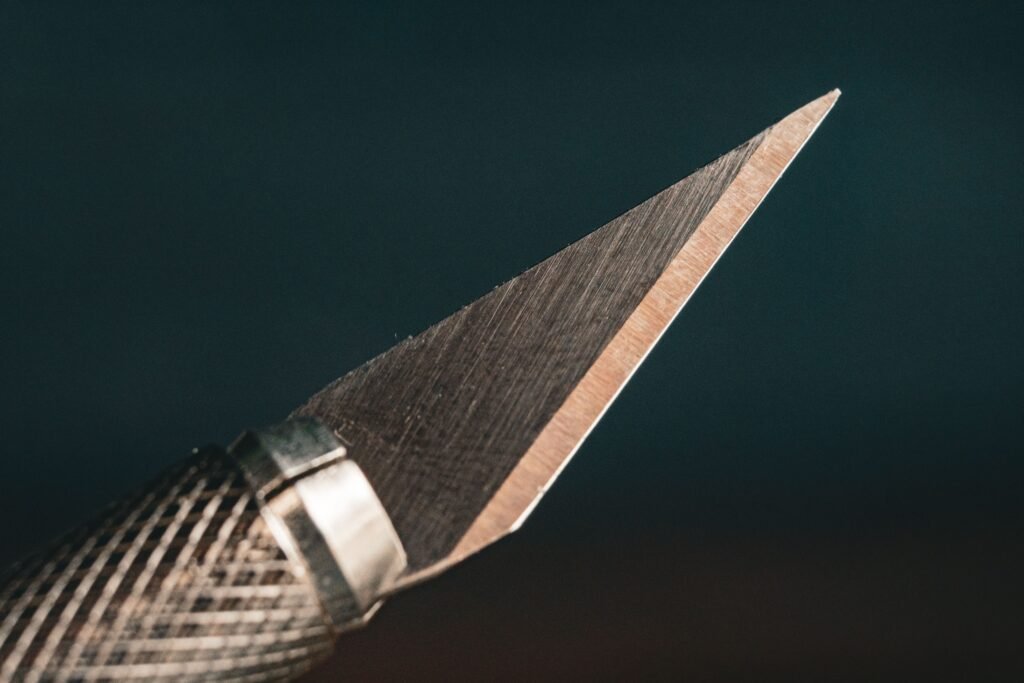
A knife may seem like an obvious substitute for a corkscrew, but it can slip unexpectedly. The combination of a smooth glass bottle and a sharp blade creates a poor setup for applying significant force.
If the knife slips, the injury risk is much greater than with a purpose-built opener.
Hitting the bottle against a hard surface
Another commonly suggested trick involves placing the bottle against a shoe, wall, or other surface and striking it repeatedly. The idea is to use pressure and impact to move the cork outward.
The problem is that glass can crack or break when subjected to repeated impacts. The method also gives you limited control over how much force reaches the bottle.
It is better to use a tool designed to remove the cork rather than relying on impact.
Heating the bottle
Another method that’s best avoided is applying heat to a capped bottle of wine hoping to push the cork out. Uneven heat on glass will induce thermal stress. The wine and bottle could also reach an uncomfortable, perhaps even dangerous to handle, temperature.
It’s hardly worth taking that kind of risk when you have mechanical options to do it more easily.
Using excessive force
Strength is rarely the solution to a stubborn cork. If the cork does not move, increasing the force can cause it to split, break, or pull the bottle in an unstable direction.
Controlled leverage is much more useful than brute force.
Special Cases: Synthetic, Old, and Oversized Corks
Corks aren’t all the same.
Natural cork is sometimes softer and less porous than synthetic corks, and they may need a slightly longer to screw into but are much less likely to fall apart and be crumbly.
Vintage natural corks are more susceptible to being crumbly too. If there is some definite age to your bottle, then assume the cork is fragile throughout. Your traditional screw can sometimes pull right through the deteriorated cork.
Some bottles simply have long and/or wide corks. If your corkscrew doesn’t get down into enough of the cork to form a strong grip you won’t really know until you try pulling it out and leaving it partially pulled out and harder to pull any more out than that.
When this happens, a special wine opener might be best. Two-pronged openers work particularly well for fragile corks by limiting the amount you have to force your opener through to create the hold.
How to Remove Cork Pieces From Wine
A cork that comes out in pieces doesn’t automatically mean the wine is ruined.
Pour out the wine slowly, through a clean fine mesh sieve, into a suitable vessel (or a decanter). It’s also possible to try and pour while observing the neck and bottle lip and ceasing pouring if substantial chunks appear in the opening before falling into the glass.
Don’t use non-hygienic kitchen materials as an emergency filter. Only material which will come in contact with the wine should be clean, food safe and suitable.
The presence of cork particles can perhaps alter the texture of a sip, however the mere presence of cork is different from a wine flaw, which can involve separate changes in the wine’s aroma or taste. If the wine actually smells and/or tastes musty, moldy or otherwise ‘off’, the problem might not even be the actual chunks of cork.
For an older and/or valuable wine it’s usually best to move the bottle as little as possible, handle carefully and use a cork remover rather than attempting to violently force out the chunk.
How to Prevent Cork Problems in the Future
It’s quite simple: the easiest bottle-opening problem to fix is one you never create. You should always keep an opener and a functioning corkscrew near your wine, and you should endeavor not to leave them where they could be broken or lost. For wines that have been aged for many years, examine the cork and neck for degradation.
If you’re dealing with a cork that is unnaturally dry or appears damaged, be ready for its eventual crumbling.
It’s often worth springing for a better quality opener, especially when choosing reliable wine accessories and tools for opening and serving bottles. Very cheap openers may employ delicate or incorrectly angled worms that simply won’t grasp the cork securely; a stronger opener with an adequately designed worm and solid leverage will make for much more uniform and effortless turning and extracting. Make sure the bottle stays on an even surface and that you hold it steady at the neck. Center the worm before you begin to twist it in and pull the cork straight up as you finish your turn, making gradual movements the whole way.
When Should You Stop Trying?
There’s a place where improvisation is not worth it anymore.
Stop if the bottle has a crack, the glass is broken, or you can not hold the bottle securely. Also stop if any tool fails more than two times, or if you need a lot of force.
Be very careful with very old or expensive bottles. With a very bad cork on an old and valuable wine, you want to have the right tool or let someone who can handle old bottles do it for you rather than try anything from your kitchen.
The idea is to un-cork the bottle safely – not to show you can tackle anything thrown at you.
Final Takeaway
Knowing how to get a cork out of a wine bottle is mostly a matter of using the right amount of leverage and choosing a method that matches the condition of the cork. Still, the safest, most efficient choice for opening a bottle of wine is a high-quality corkscrew, and you can use a hardy screw and pliers as a workable substitute.
Keys and improvised methods can work for simple cases, but are trickier; don’t apply additional pressure if the cork begins to crumble, and a waiter’s friend is advisable with this technique. Most important: avoid sharp implements and overwhelming force, including pounding and heating the bottle-opening quickly should never trump protecting the bottle from the corkscrew, and your hands from becoming the corkscrew, in that order.
Frequently Asked Questions
1.What is the easiest way to remove a cork from a wine bottle?
The easiest and safest method is to use a corkscrew. Center the screw in the cork, twist it in deeply enough to get a secure grip, and pull the cork upward slowly using the opener’s leverage.
2.Can I remove a wine cork without a corkscrew?
Yes. A sturdy screw and pliers can work as an alternative. A strong key may also work with a firm cork, but these methods require more care because the tool can slip or the cork can break.
3.What should I do if the cork breaks inside the bottle?
If the cork breaks, try removing the remaining portion with a corkscrew if it is still large enough to grip. If pieces fall into the wine, pour the wine through a clean fine-mesh strainer to remove the fragments.
4.Can I push the cork into the wine bottle?
Yes, pushing the cork inside can be used as a last resort when removing it intact is not practical. Use a clean, blunt object and apply slow, controlled pressure. Afterward, filter the wine if cork pieces are present.
5.How do I remove a fragile or crumbling cork?
Use gentle pressure and avoid repeatedly forcing a conventional corkscrew through the same weak area. A two-pronged wine opener can be useful for very fragile natural corks because it grips the cork from the sides.
6.Is it safe to open a wine bottle with a knife?
Using a sharp knife is not recommended. The blade can slip while you are applying force, potentially causing an injury or damaging the bottle. A corkscrew or another controlled method is a safer choice.
7.Why does a wine cork crumble when I try to remove it?
Natural cork can become dry, brittle, or deteriorated over time. Older bottles are particularly likely to have fragile corks that break during extraction. Pulling too aggressively can also cause a weak cork to crumble.
8.What should I do if my corkscrew gets stuck?
Keep the bottle upright on a stable surface and use the corkscrew’s leverage gradually. If the cork is already damaged and the screw cannot grip it securely, stop forcing it and consider switching to another suitable removal method.
Conclusion
Knowing how to get a cork out of a wine bottle becomes much easier when you match the removal method to the condition of the cork. A good quality corkscrew is the most recommended method, however, in the event a corkscrew isn’t available a screw driven into the cork along with pliers provides a reliable fallback option when a corkscrew cannot be used to loosen and extract the cork from the bottle.
Brittle and old corks will require patience as a vigorous tug can often cause the cork to break. If pieces of a shattered cork have gotten into the wine they can usually be removed easily by straining the wine while pouring it through cheesecloth or a fine sieve.
While there are many “kitchen tricks” out there with sharp knives, brute force, heat and hitting the bottle this is far too risky and could lead to danger.
This guide focuses on using a reliable method with a good corkscrew, maintaining a steady grip, steady bottle position, slow pull, controlled steady pressure.








