

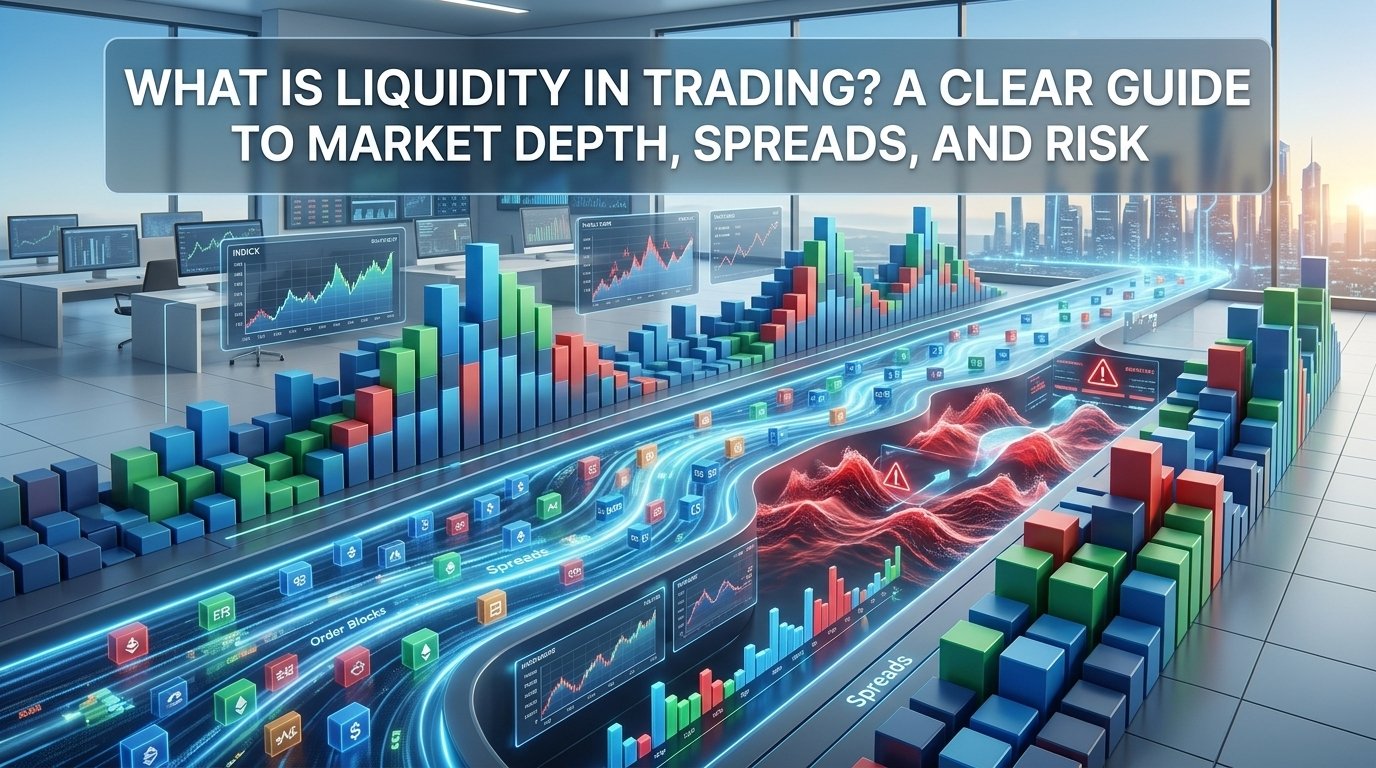
Trading liquidity describes the ease with which an asset can be bought or sold in the market without affecting the price of that asset significantly. Highly liquid markets often feature numerous enthusiastic buyers and sellers in the market, narrow bid-ask spreads, and sufficient trading activity to manage the necessary volume with ease. Lower liquidity markets include higher spreads, increased price volatility and challenges in executing large orders at the desired price.
You can benefit from understanding liquidity regardless of the specific market in which you trade be it stocks, foreign exchange (forex), digital currencies, commodities or others. It isn’t the only determinant of how rapidly your order gets fulfilled. Liquidity has a bearing on price slippage, transaction costs, volatility, position size as well as the actual risk entailed in entering or exiting a trade.
A market might appear to be in a healthy condition externally while still exhibiting limited liquidity around the exact price level that matches your needs. For this reason, traders meticulously scrutinize the volume, order-book breadth, the spreads, and the trading frequency prior to initiating large orders.
This article will address the inner workings of liquidity, how its levels fluctuate, techniques for distinguishing between liquid and illiquid situations and considerations prior to making bets on it.
Understanding Liquidity in Financial Markets
At its simplest, liquidity describes the ease of converting an asset into cash or moving from cash into an asset—without substantially affecting its market price.
Consider a heavily traded stock with thousands of buyers and sellers continuously placing orders. If you’re wondering what is liquidity in trading, this is a practical example: if you want to sell a modest number of shares, there may be enough buyers near the current market price to absorb your order. Your transaction is therefore less likely to move the price significantly.
But in thinly traded stocks, you’ll find very few buyers in the market. Those buyers might even place bids at various different prices. This means that even a relatively small sell order could gobble up all the available demand and force the price down. You might eventually be able to sell, just not at the price you envisioned.
This distinction is central to understanding liquidity.
Liquidity Is Not the Same as Volume
Volume is about the quantity of a asset that has traded at a given period. Liquidity is wider that a certain period of trading is it is only about the ease of which a market can take or give position, close or open position on an existing market prices (or very close from it). It’s possible to be in a very active market with little liquidity, and opposite on an asset who is normally active, outside of active period its order book is likely very thin.
For traders, the quality of available orders matters alongside the total amount traded.
The Role of Buyers and Sellers
Liquidity depends on participation from both sides of the market. Buyers provide bids, while sellers provide offers or asks.
When considering what is liquidity in trading, one key factor is the number of participants willing to transact around similar prices. Generally, where most buyer and sell activities occur in roughly similar price bands liquidity in the market will be greater. Conversely, if there is large disparity in where sellers offer and buyers bid at then trading may be inefficient.
This is where an order book comes in handy, especially where detailed information is available about market depth.
Why Liquidity Matters to Traders
Liquidity can affect almost every stage of a trade, from entry to exit.
A liquid market generally makes it easier to enter and close positions without significant price disruption. This can be especially important for active traders, institutions, and anyone managing larger positions.
Lower Transaction Friction
Markets can be much more efficient (have tighter bid-ask spreads) on more liquid securities. This spread represents the difference between the highest price anyone is willing to buy the securities and the lowest price anyone is willing to sell the securities. For instance, let’s say Stock X is trading at a bid of $99.99 and a price of $100.01.
The spread here is $0.02.
On the other hand let’s say Security Y is trading at a bid of $99.00 and a price of $101.00. Spreads change constantly so traders need to take conditions into account at the time the order will be placed rather than to assume a particular market will be at a similar spread.
More Predictable Execution
Liquidity can also ensure more reliable execution. When orders are close to the prevailing price, entering a market order won’t necessarily see the order jump around a number of levels. However execution risk isn’t completely avoided – even in very liquid markets unexpected movements can occur around major news breaks, during market opens, or due to significant fluctuations.
Reduced Slippage
Slippage occurs when the execution price differs from the price a trader expected.
For example, you might submit a market order to buy an asset while it is trading near $50. If available sellers at $50 quickly disappear, your order could be filled partly or entirely at higher prices.
Strong liquidity can reduce this problem, although it cannot guarantee a particular execution price.
What Determines Market Liquidity?
Liquidity is not fixed. It can vary by asset, exchange, trading session, market conditions, and market liquidity.
Several factors are particularly important.
Trading Activity
Understanding what is liquidity in trading starts with recognizing that markets with consistent participation from many buyers and sellers tend to have stronger liquidity. Major currency pairs, widely followed stocks, and heavily traded futures contracts often attract substantial participation.
An asset that rarely changes hands may have fewer available counterparties, making transactions more difficult.
Bid-Ask Spread
The bid-ask spread is one of the easiest liquidity indicators to observe.
An asset with a tight spread would usually indicate that buyers and sellers are relatively close in their thinking. A wide spread might imply poor liquidity and lack of consensus. It should not be taken on face value, an asset could for a while have tight spread but poor depth.
Market Depth
Market depth refers to the quantity of buy and sell orders available at various price levels.
To understand what is liquidity in trading, imagine an order book where only a small number of shares are available at the current ask, followed by larger price gaps at higher levels. A large market order could move through those levels and produce noticeable slippage.
Greater depth generally gives larger participants more room to transact without dramatically moving the market.
Asset Characteristics
There will always be a greater deal of activity attracted to certain financial instruments. Major established market places could witness significantly large amounts of traders active, but obscure securities or new issues of coins could be a lot thinner. Therefore the market infrastructure in place is an essential variable.
Time of Day
Liquidity can change throughout a trading session.
For example, markets may become particularly active around major market openings or periods when multiple global trading centers overlap. Activity can decline during quieter periods.
Traders should therefore avoid assuming that an instrument has identical liquidity throughout the day.
News and Economic Events
Major announcements can dramatically change liquidity conditions.
Economic reports, central-bank decisions, corporate earnings, geopolitical developments, and unexpected events can trigger rapid order cancellations and new orders, making liquidity risk an important consideration for traders. Understanding what is liquidity in trading can help explain why, during these periods, spreads may widen and slippage can increase.
A market that normally appears highly liquid can behave very differently during a sharp price shock.
Liquidity Across Different Markets
Liquidity looks different depending on the financial market being traded.
Stocks
Large capitalization stocks in which significant retail and institutional investment is drawn typically enjoy a considerable amount of liquidity. Smaller securities where relatively little trading volume goes through may feature wider bid-ask spreads and shallower trading pools. Exchange-traded funds come in all stripes. Some are highly liquid and regularly trading while others scarcely change hands.
Forex
The foreign exchange market is generally highly active, particularly in major currency pairs. Yet liquidity varies between currency pairs and trading sessions.
Major pairs typically have more participation than less frequently traded combinations. Market conditions can still change around economic announcements or periods of unusual volatility.
Cryptocurrency
Crypto markets vary widely in liquidity. A major cryptocurrency traded across large exchanges may have substantial activity, while a small token may have relatively little depth.
This creates an important distinction: a token’s quoted price does not necessarily mean that a large position can be bought or sold close to that price.
Commodities and Futures
Liquidity varies for each individual futures contract and expiration month. The more actively trading contract may possess substantially more depth than a lesser-traded maturity date. Traders should actually view the contract on which they are trading and not presuppose that the market has equal liquidity across all futures products.
How to Measure Liquidity Before Trading
There is no single number that completely captures liquidity. Instead, traders can examine several indicators together.
Check the Bid-Ask Spread
Start by looking at the current bid and ask.
A consistently narrow spread is generally favorable for trading costs. If the spread suddenly becomes much wider than normal, it may signal reduced liquidity or increased uncertainty.
Examine Trading Volume
Volume provides context about how actively an asset is being traded.
Rather than looking at a single volume figure, compare current activity with the instrument’s normal trading pattern. An unusual increase or decrease may indicate changing market conditions.
Review Market Depth
If your trading platform provides Level 2 or order-book information, examine how much buying and selling interest exists near the current price.
Pay particular attention to large gaps between price levels. These gaps can become relevant when placing larger orders.
Consider Your Order Size
Liquidity is relative to the size of the transaction.
An asset may be highly liquid for a small retail order but considerably less liquid for a large institutional transaction. Your position size should therefore be evaluated against the available market depth.
Market Orders vs. Limit Orders in Different Liquidity Conditions
The type of order may be more critical in low liquidity, especially when considering trading execution and potential price slippage. A market order emphasizes getting filled – it tries to execute immediately at whatever is offered or asked price, which can result in a final price different from the last quoted price. A limit order lets you set a price that is the maximum amount you’re willing to pay for shares you buy, or the minimum you will sell at. This lets you control your price but there’s no guarantee you will be filled.
When Liquidity Is Strong
In a deep market with a tight spread, a market order may experience relatively little slippage under normal conditions.
Even so, traders should not assume that a quoted price will remain available, especially during fast markets.
When Liquidity Is Weak
In a thin market, a market order can be more vulnerable to price movement because there may not be enough orders at the best available price.
A limit order can provide greater control, but the trade may remain unfilled if the market never reaches the specified price.
Neither order type is universally superior. The appropriate choice depends on the asset, trading objective, urgency, and current conditions.
How Low Liquidity Can Increase Trading Risk
Illiquidity creates several risks that may be easy to overlook.
Slippage Risk
A trader may receive a significantly different execution price than expected, particularly with larger market orders.
Exit Risk
An asset may be easy to buy but difficult to sell in the desired quantity. This can happen when market participation falls or when a trader holds a position that is large relative to available demand.
Volatility Amplification
Thin markets can react sharply when relatively large orders enter or leave. A modest amount of buying or selling may therefore produce a disproportionate price move.
Wider Spreads
Reduced participation can cause the gap between bids and asks to increase. This raises the cost of entering and exiting positions.
Stop-Loss Considerations
You will not always have an order that fills at exactly the stop loss price during fast and very thin markets-a move through that level may take place before the order is executed. This may be true when involved with leveraged trading where even small changes in price could greatly impact account equity.
Common Mistakes Traders Make
Liquidity is often misunderstood because traders focus on the displayed price rather than the conditions surrounding that price.
Mistaking a Low Price for Good Liquidity
A cheap asset is not automatically easy to trade. Liquidity concerns the availability of counterparties and executable prices, not whether the asset itself has a low nominal price.
Looking Only at Daily Volume
Volume is useful, but it does not tell the entire story. The timing of that volume, spread, order-book depth, and typical order size also matter.
Ignoring Liquidity During News
Normal market conditions can change quickly after important announcements. Traders who base their execution expectations on quiet-market conditions may be surprised by wider spreads and increased slippage.
Using Large Market Orders in Thin Markets
A large market order can consume available liquidity across multiple price levels. Splitting an order or using limit orders may sometimes provide greater control, depending on the strategy.
Assuming Liquidity Is Permanent
Liquidity can disappear. A market should be evaluated based on current conditions rather than its reputation alone.
How Traders Can Manage Liquidity Risk
Liquidity risk cannot always be eliminated, but it can be managed.
Before entering a position, consider whether you could reasonably exit it under less favorable conditions. This question is particularly useful for smaller securities, niche markets, and volatile digital assets.
Position size is another important consideration when learning what is liquidity in trading. A trade that forms part of a fraction of typical market activity may be easier to work with as part of than that which forms a significant percentage of the current orders on display. It is possible to check what prices were charged at various points during the day, and observe price action at peak times.
Appropriate positioning Size within the instrument’s normal trading pattern can minimize trade execution problems. For large orders consideration will need to be given to techniques suitable for dealing that order which prevent having to insert the entire order at a single time on an exchange; this will vary according to asset, market, strategy and desire to transact.
Is High Liquidity Always Better?
High liquidity is typically the order of the day for traders: easy execution and low friction come at a great benefit for trading. However, it is not high liquidity by itself that leads to optimal trades and investment decisions. A highly liquid asset can exhibit high volatility.
It can shed a lot of its value as a result of macro events, company fundamentals or just the market in general.
Conversely, even illiquid assets may give rise to interesting opportunities, albeit they carry extra friction and exit risks. So the right question shouldn’t necessarily be the liquidity of the asset, but: is this asset liquid enough for my trade size, trading strategy, time frame, and appetite for risk?
When Liquidity Conditions Deserve Extra Attention
Some situations require greater caution than normal.
Pay close attention when trading:
- Small-cap or lightly traded securities
- Newly launched financial assets
- Thin cryptocurrency markets
- Contracts approaching expiration
- Markets outside their most active trading hours
- Assets experiencing unusual volatility
- Instruments affected by major news
In these circumstances, checking the spread and available depth immediately before placing an order can be more useful than relying on historical averages.
Final Takeaway
Liquidity is a necessary factor to understand when implementing responsible trading behavior. Liquidity can best be described as the ease of which an asset can be traded without adversely affecting the price, as well as how quickly one can buy and sell at price, the effects on spreads and slippage, quality of execution, and ease of getting out of a trade. The key way to consider it effectively isn’t just a consideration of volume.
One has to look at bid/ask spread, market depth, flow at the time of trading, size of the order, time of day, anticipated economic news which will likely affect the market.
Normally easy markets, however, turn very volatile when extreme situations develop and create difficult trading conditions. The most practical approach towards risk management means accounting for the fact that one may have to adjust one’s size, type of order, to reflect the liquidity which exists and is available. Good liquidity may not imply that there will be no market risk, however, awareness of liquidity issues could save one time, the extra cost in execution prices, and generally increase trading precision.
FAQs About Liquidity in Trading
1. What is liquidity in trading?
Liquidity in trading refers to how easily an asset can be bought or sold near its current market price without causing a significant price movement. Highly liquid markets generally have many buyers and sellers, tighter bid-ask spreads, and greater market depth.
2. Why is liquidity important for traders?
Liquidity affects how easily traders can enter and exit positions, as well as the cost and quality of execution. Poor liquidity can lead to wider spreads, greater slippage, and increased price impact, particularly when placing larger orders.
3. What is the difference between liquidity and trading volume?
Trading volume measures how much of an asset changes hands during a particular period, while liquidity describes how easily transactions can occur without significantly affecting the price. High volume can indicate strong liquidity, but volume alone does not provide a complete picture.
4. How does the bid-ask spread show liquidity?
The bid-ask spread is the difference between the highest price buyers are offering and the lowest price sellers are accepting. A narrow spread generally indicates stronger liquidity and lower immediate transaction costs, while a wider spread can indicate weaker liquidity.
5. Can liquidity change during the trading day?
Yes. Liquidity can change depending on trading activity, market hours, news, volatility, and the number of active participants. A market that is normally liquid can temporarily become less liquid during periods of uncertainty or major market disruptions.
6. What is market depth?
Market depth refers to the amount of buy and sell interest available at different price levels around the current market price. A deeper market can generally absorb larger orders with less price impact, while a shallow market may react more sharply to relatively small transactions.
7. Does low liquidity increase slippage?
It can. When there are not enough orders available near the desired execution price, an order may be filled at progressively less favorable prices. This difference between the expected and actual execution price is known as slippage.
8. Are stocks, forex, and cryptocurrencies equally liquid?
No. Liquidity varies significantly between markets and individual assets. Even within the same market, one instrument may have substantially more trading activity and order-book depth than another. Liquidity can also change depending on the trading session and current market conditions.
9. Is high liquidity always better?
High liquidity is generally helpful because it can make transactions easier and reduce certain execution costs. It does not, though, eliminate investment risk or guarantee that an asset’s price will remain stable. A highly liquid market can still experience substantial volatility.
10. How can traders check liquidity before placing an order?
Traders can examine several factors together, including the bid-ask spread, trading volume, order-book depth, recent execution activity, and the size of the intended position. Looking at these factors together gives a more useful picture than relying on volume alone.
Conclusion
Liquidity is also integral to any trading setup as it influences the ease with which prices can be entered or exited, and how accurately an executed trade’s price will reflect a trader’s desired price. A tight bid-ask spread, good depth of market and high volume of activity typically signifies better liquidity in a market, while thin markets tend to result in wider bid-ask spread, slippage, and a more pronounced market impact. The most important thing to keep in mind, however, is how liquid the asset is as it pertains to your trade.
A market that is liquid enough for a minor entry may be a poor liquidity market for entry size.
Reviewing the bid-ask spread, current volume and order-book depth should give a trader an idea of what to expect by way of transaction costs before initiating the position.








